Skip to content
AICE Power

Menu

Our SolutionCase StudyBlogContact
Theme
Language
Electricity Submetering: What Europe Now Requires and Why It Pays for Itself

Electricity Submetering: What Europe Now Requires and Why It Pays for Itself

Remi BouteillerApr 14, 2026

Picture this. You manage forty retail sites across France and Germany. Your electricity bills arrive monthly, each one a single number. You know what you spent, but you have no idea where the energy actually went. Was it the refrigeration? The HVAC? The bakery ovens left running overnight? You're flying blind, and European regulators are about to make that unacceptable.

The revised Energy Performance of Buildings Directive (EPBD), the BACS mandate, and a wave of national regulations are converging on one principle: buildings must prove they manage energy actively, not passively. That proof requires granular data. And granular data requires submetering.
Key Takeaways
  • The EPBD recast (2024) must be transposed into national law by May 2026, with BACS mandates requiring continuous energy monitoring in non-residential buildings
  • France, Germany, the UK, and the Nordics each enforce distinct submetering and monitoring rules, with thresholds dropping rapidly
  • Submetering delivers 15-45% energy savings when paired with continuous commissioning (FEMP)
  • Clip-on CT sensors offer the fastest path to compliance, with payback periods under 12 months
  • Submetering data feeds Decret Tertiaire, CSRD, and ISO 50001 compliance simultaneously

What Is Submetering, and How Does It Differ from Main Metering?

A main meter measures total electricity consumption for an entire building. It tells you how much you spent. Submetering breaks that total into circuits, systems, or zones, revealing exactly where the energy flows.

Think of it like a bank statement. Your main meter shows the account balance. Submeters show every transaction. Without those transactions, you cannot identify waste, benchmark systems, or prove compliance with reduction targets.

Our finding: Across 1,500+ monitored sites, facilities with circuit-level submetering identify actionable savings within the first 30 days. Sites relying on main metering alone take an average of 6 months to surface the same issues, if they ever do.

The Monitoring Hierarchy

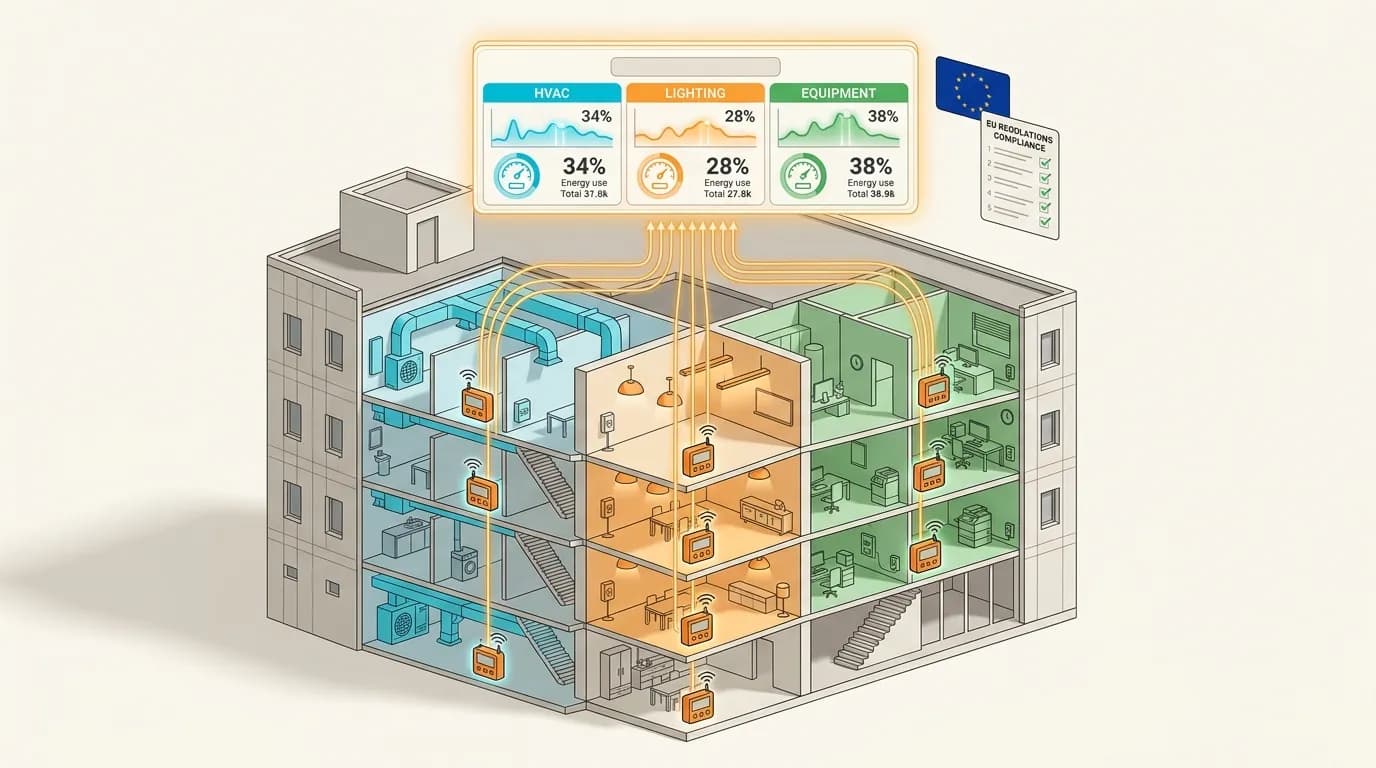
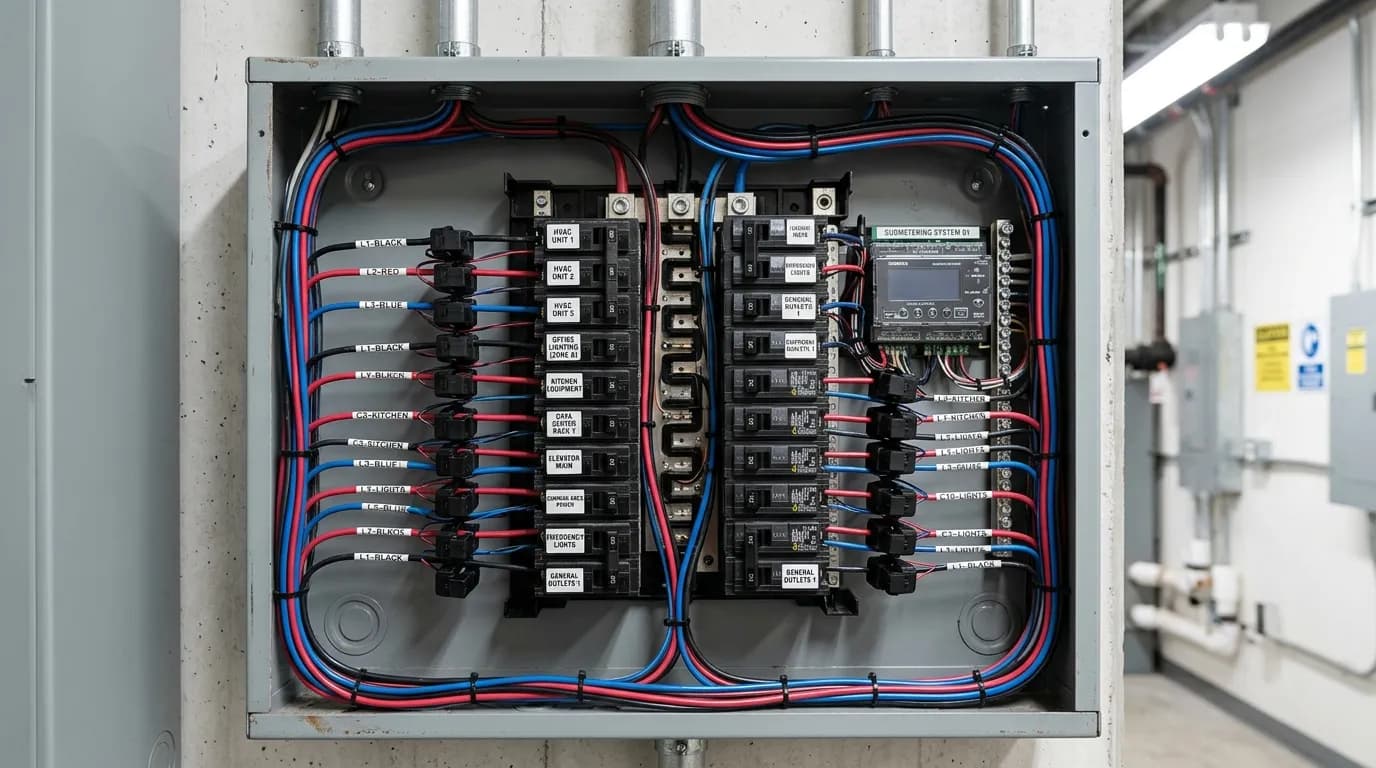
There are three levels of energy monitoring. The first is utility metering, a single point measuring everything entering the building. The second is system-level submetering, which separates consumption by major systems like HVAC, refrigeration, lighting, and plug loads. The third is circuit-level submetering, which monitors individual distribution boards and critical equipment.

European regulations are rapidly pushing buildings from the first level to the second and third. Why? Because you cannot reduce what you cannot measure at the right granularity.
Isometric building floor showing three separate submetered circuits for HVAC, lighting, and equipment

What Does the EPBD Recast Actually Require?

The revised EPBD (EU/2024/1275) entered into force in May 2024. All EU member states must transpose it into national law by 29 May 2026 (European Commission, 2025). The directive does not use the word "submetering" on every page, but its mandates make granular monitoring a practical necessity.

Here is what the EPBD demands. Non-residential buildings must renovate in waves: the worst-performing 16% by 2030 and 26% by 2033. Building Automation and Control Systems (BACS) become mandatory for all non-residential buildings above 290 kW, dropping to 70 kW by 2030. Smart readiness indicators must demonstrate a building's capacity to optimize performance over time.

Can you prove continuous energy optimization without knowing how each system performs? You cannot. That is why the EPBD, while not explicitly mandating individual submeters, implicitly requires them.

BACS Mandate Timeline: Threshold Reduction0 kW70 kW290 kW290 kW2025290 kW202770 kW2030Source: EPBD recast EU/2024/1275
The BACS mandate progressively covers more buildings as the power threshold drops from 290 kW to 70 kW.

How Does the BACS Decree Force Submetering in Practice?

The BACS mandate is the sharpest regulatory driver for submetering. A BACS-compliant system must continuously monitor, log, and analyze energy consumption across building systems (Spectral, 2026). It must also benchmark performance and actively identify improvement opportunities.
The European building automation systems market reflects this urgency. It reached USD 19 billion in 2026 and is projected to hit USD 29 billion by 2031, growing at 8.8% annually (GlobeNewswire, 2026).

You cannot benchmark HVAC performance against refrigeration performance if both share a single meter. You cannot identify an underperforming chiller if it is buried inside total consumption data. BACS compliance, in practice, demands system-level submetering at minimum.

France has moved faster than most. The French BACS decree already requires automation for existing buildings above 70 kW since January 2025 (Adeunis, 2025). That covers the majority of commercial buildings, including supermarkets, hotels, logistics centres, and multi-site retail portfolios.
Learn how energy alerts outperform static dashboards when paired with submetered data.

Which Countries Require What? A Regulatory Map

Every EU member state must transpose the EPBD by May 2026, but national implementation varies widely. Here is what facility managers need to know for each major market.

France

France leads in regulatory stringency. The Decret Tertiaire mandates energy reductions of 40% by 2030 for all tertiary buildings over 1,000 m². The BACS decree already applies to buildings above 70 kW. And the OPERAT platform requires annual energy consumption reporting, with the next deadline set for September 30, 2026 (Service Public, 2026).

In practice, French facility managers cannot meet Decret Tertiaire targets without granular monitoring. How else would you prove a 40% reduction across diverse building systems?

Our guide on understanding your commercial electricity bill covers the French tariff structures that make submetering especially valuable.

Germany

Germany's Building Energy Act (Gebaudeenergiegesetz) now mandates minimum building automation for all existing non-residential buildings as of January 2025, requiring continuous monitoring, analysis, and optimization of energy consumption (Aedifion, 2025). Smart metering has also shifted from voluntary to mandatory, with metering operators now obliged to install 15-minute interval smart meters within four months of commissioning (ADVANT Beiten, 2025).

United Kingdom

The UK's Part L Building Regulations have long required submetering in new non-residential buildings. Specific thresholds include separate metering for motor control centres above 10 kW, boilers above 50 kW, chillers above 20 kW, and distribution boards above 50 kW (Sitemate, 2025). The updated Part L 2026 edition, coming into force in March 2027, further tightens energy performance standards (UK Government, 2026).

Nordics

All Nordic countries completed smart meter rollouts by January 2025, with mandatory 15-minute data logging and open standard customer interfaces (Nordic Energy Research, 2025). Sweden is introducing mandatory energy performance standards for commercial buildings, with specific values expected to become mandatory by mid-2025 (Nordea, 2025). Denmark is tightening building energy limits in 2025, 2027, and 2029.

Spain

Spain's Technical Building Code (CTE) is undergoing a major revision expected in the second half of 2026. The new Basic Document on Environmental Sustainability (DB-SA) will reinforce energy consumption requirements, particularly for air conditioning and thermal insulation (Praxis, 2025). Renovations touching more than 25% of a building's envelope already trigger full compliance with new-build energy standards.
European Submetering Regulatory Timeline202520262027-2030FRBACS 70 kW activeOPERAT deadlineDEGEG automationSmart meter mandateUKPart L in forcePart L 2026SE/DKSmart meters donePerf. standardsESCTE revisionDB-SA activeActiveDeadlineUpcoming
Regulatory timelines vary by country, but the direction is universal: more granular energy monitoring, sooner.

What Should You Submeter? Breaking Down by System

Not every circuit needs its own sensor. Smart submetering means focusing on the systems that consume the most and drift the most. Here is how to prioritize.

HVAC

Heating, ventilation, and air conditioning typically accounts for 40-60% of a commercial building's energy use. Submetering HVAC separately reveals seasonal inefficiencies, scheduling errors, and equipment degradation. A chiller running at 30% above its rated consumption is invisible on the main meter but obvious on a dedicated submeter.

Learn how load shifting can reduce HVAC peak demand costs by rescheduling pre-cooling cycles.

Refrigeration

For supermarkets and food retail, refrigeration consumes roughly 50% of total electricity (Energy Star / EIA). Submetering individual cold rooms and display cases exposes door seal failures, defrost cycle anomalies, and compressor inefficiencies within hours instead of weeks.
Our deep dive on refrigeration flexibility explains how submetered refrigeration data enables demand response participation.

Lighting

Lighting is often the easiest win. Submetering lighting circuits reveals after-hours waste and zones where occupancy-based controls would pay for themselves in months. Our analysis of after-hours energy waste shows that many retail sites consume 30-40% of their lighting energy outside operating hours.

Plug Loads and Specialty Equipment

Bakery ovens, kitchen equipment, IT rooms, and electric vehicle chargers can all create hidden consumption peaks. Without submetering, these loads are invisible. With it, facility managers can schedule non-critical equipment outside peak tariff windows.

See how supermarket energy monitoring breaks consumption into actionable categories.

How Fast Does Submetering Pay for Itself?

The US Federal Energy Management Program (FEMP) found that submetering, combined with continuous commissioning, delivers 15-45% energy savings (FEMP Metering Best Practices). When tenants or departments pay directly for their measured consumption, overall building energy use drops by as much as 20% (Triacta, 2025).
Our finding: Across our client portfolio, the median payback period for a clip-on CT sensor deployment is 9 months. Sites with the highest waste baselines see payback in under 6 months. The key driver is not the technology cost but the speed at which teams act on the data.

The Savings Breakdown

Where does the money come from? Three main sources.

Waste elimination. Submeters expose equipment left running when it should not be, heating and cooling fighting each other, and schedules misaligned with occupancy. Our experience shows this accounts for 40-60% of first-year savings.
Maintenance optimization. Consumption anomalies are early warnings for equipment failure. Catching a failing compressor through its energy signature costs a fraction of an emergency repair. Explore how energy alerts beat static dashboards for rapid fault detection.
Tariff optimization. Understanding when each system draws power enables load shifting to lower-cost periods. This alone can reduce electricity costs by 5-15% without changing total consumption. Learn more about load shifting strategies.

Do the savings justify the investment? For a building spending 100,000 euros annually on electricity, even a conservative 15% reduction means 15,000 euros saved per year. A typical clip-on sensor deployment for that building costs 8,000-15,000 euros. The math is straightforward.

Discover how energy savings without capex works in practice across multi-site portfolios.

Clip-on Sensors vs. Hardwired Submeters: Which Approach Wins?

There are two main paths to submetering. Hardwired submeters require integration into the electrical panel by a qualified electrician, with the circuits physically interrupted during installation. Clip-on current transformer (CT) sensors clamp around existing cables without breaking any connections (Attune IoT, 2017).

For multi-site commercial portfolios, clip-on CT sensors offer decisive advantages.
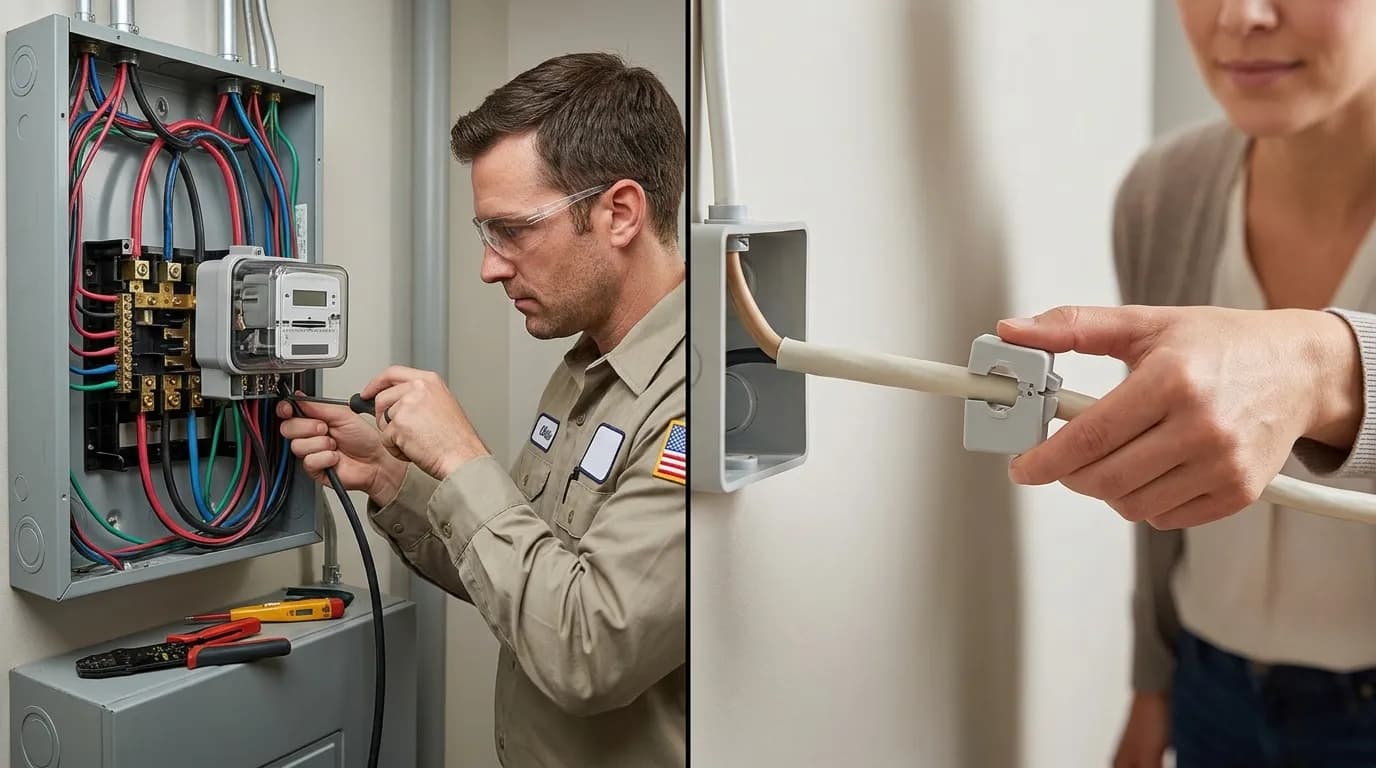
Isometric comparison of hardwired submeter installation versus non-invasive clip-on CT sensor
Installation speed. A full site deployment takes hours, not days. No circuit interruptions, no downtime for the business.
Scalability. Adding monitoring points is as simple as clipping on another sensor. There is no need to redesign the electrical panel.
Cost. CT sensor deployments typically cost 40-60% less than equivalent hardwired installations for the same number of monitoring points.
Accuracy. Modern split-core CTs achieve 1-2% accuracy, which is more than sufficient for energy management, fault detection, and compliance reporting.
Our finding: AICE deploys clip-on CT sensors across all client sites. Average installation time per site is under 4 hours, with zero operational disruption. This speed matters when rolling out across 20, 50, or 200 locations.

The trade-off? Hardwired submeters can offer billing-grade accuracy (0.5% or better) required for tenant billing in multi-occupancy buildings. For energy management and compliance, however, CT sensors deliver the data quality you need at a fraction of the cost and disruption.

How Does Submetering Feed Compliance Reporting?

Submetering is not just about savings. It is the data backbone for three major compliance frameworks.

Decret Tertiaire (France)

The Decret Tertiaire requires buildings over 1,000 m² to report energy consumption annually on the OPERAT platform. You need to demonstrate progress toward a 40% reduction by 2030. Submetered data lets you show exactly which systems improved and by how much, which is far stronger than a single main meter number.

CSRD (EU-Wide)

The Corporate Sustainability Reporting Directive requires large companies to report environmental metrics, including energy consumption, in a reliable, comparable, and verifiable format (European Commission, 2024). Submetered data provides the granularity and audit trail that CSRD auditors expect. The first CSRD reports covering FY2025 are due in 2026 for the largest companies, with broader applicability expanding in subsequent years.

ISO 50001

ISO 50001 requires organizations to establish an energy monitoring, measurement, and analysis plan covering specific processes and equipment (ISO, 2025). That means you need submeters on significant energy uses. The 2024 climate amendment further requires assessing how climate change affects energy performance, making real-time data even more critical.

What all three frameworks share is a need for granular, continuous, auditable energy data. A single main meter cannot provide that. Submetering can.

See how portfolio-level analysis uses submetered data to benchmark performance across sites.

What Are the First Steps to Get Started?

You do not need to submeter everything on day one. A phased approach works best, and it aligns with how regulators expect buildings to demonstrate continuous improvement.

Phase 1: Identify your top consumers. In most commercial buildings, 20% of systems account for 80% of electricity use. Start there. For supermarkets, that means refrigeration and HVAC. For offices, it means HVAC and lighting.
Phase 2: Deploy sensors on priority circuits. Clip-on CT sensors can be installed in a single visit. No permits, no downtime, no disruption to operations.
Phase 3: Connect to a monitoring platform. The sensors are only as valuable as the analytics layer above them. Look for platforms that offer automated anomaly detection, benchmark comparisons, and alerting. Our first results guide explains what to expect in the initial 90 days.
Phase 4: Expand and automate. As you validate savings from priority circuits, extend coverage to secondary systems. Integrate with building management systems where possible.
Phase 5: Report and repeat. Use your submetered data for regulatory filings, CSRD reporting, and internal energy reviews. Each cycle reveals new opportunities.

Frequently Asked Questions

Is submetering legally required in Europe?

No single EU directive explicitly mandates submeters on every circuit. However, the EPBD recast, the BACS mandate, and national regulations like France's Decret Tertiaire and Germany's GEG create obligations that are extremely difficult to meet without submetering. The practical requirement is clear even if the legal text does not name the technology.

How much does a submetering deployment cost?

For a mid-sized commercial building with 15-25 monitoring points, clip-on CT sensor deployments typically cost between 5,000 and 15,000 euros, including sensors, connectivity, and platform setup. Hardwired submeters cost 40-60% more for equivalent coverage. Payback periods typically fall under 12 months.

Can I use submetering data for Decret Tertiaire reporting?

Yes. Submetered data provides the granularity needed for OPERAT platform submissions. It also strengthens your compliance position by documenting which specific actions produced which results, giving auditors confidence in your reported reductions.

Do I need to shut down operations to install submeters?

Not with clip-on CT sensors. They clamp around existing cables without interrupting circuits. Installation takes hours, not days, and requires no operational downtime. Hardwired submeters do require circuit interruption and qualified electrical work.

How does submetering relate to ISO 50001 certification?

ISO 50001 requires an energy monitoring and measurement plan covering significant energy uses. Submetering is the most practical way to satisfy this requirement. It provides the continuous, equipment-level data that auditors expect to see during certification reviews.

The Window Is Closing

The EPBD transposition deadline of May 2026 is weeks away. France's BACS decree for buildings above 70 kW is already active. Germany's automation mandates took effect in January 2025. The Decret Tertiaire's 40% reduction target in 2030 leaves just four years.

Every month without submetering is a month of invisible waste and missed compliance progress. The technology is mature, the installation is non-disruptive, and the payback is measured in months, not years.

The question is no longer whether you need submetering. It is whether you can afford to wait any longer.

We use cookies to improve your experience and analyze site usage. Privacy policy