Why Energy Monitoring Dashboards Don't Save Money (And What Actually Does)
Remi BouteillerApr 13, 2026
Nobody looks at their energy dashboard. You know it. We know it. The login stats prove it: most dashboards go from daily visits to total silence within six weeks.
And yet, the energy management industry keeps selling dashboards as the solution. Beautiful charts. Color-coded gauges. Historical trends. All sitting on a screen that nobody checks while the building wastes 30% of its energy.
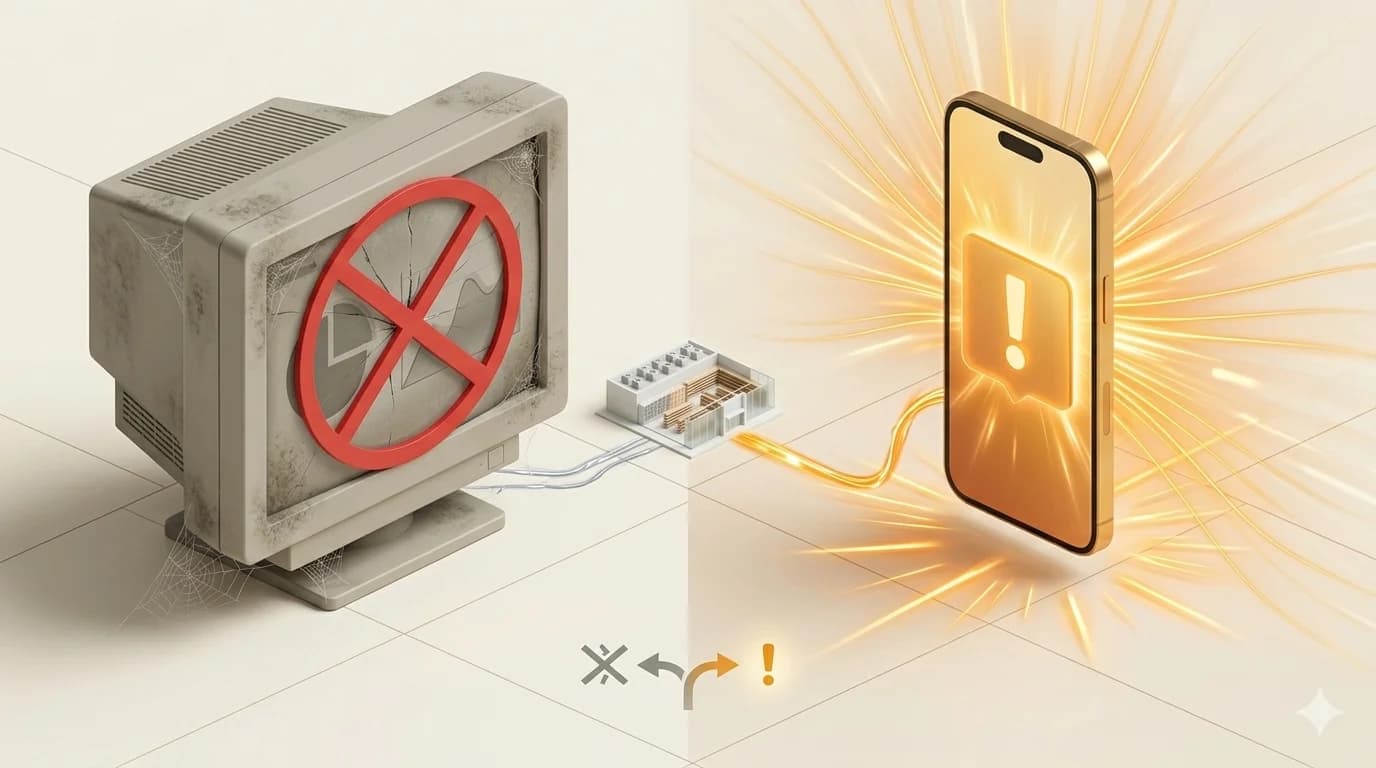
The buildings that actually cut costs aren't watching charts. They're getting text messages. A stuck damper at 2 AM. An HVAC unit running on a holiday. A demand spike that's about to blow the monthly budget. Alert-based systems catch these problems in real time and push them to people who can act. Dashboards wait politely for someone to log in.
Key Takeaways
Fault detection alert systems deliver 9% median energy savings vs. 3-4% for dashboard-only monitoring (DOE/LBNL, 2020)
70-85% of small and medium commercial buildings still lack any energy management system (ACEEE, 2025)
Alert-based retail deployments cut after-hours energy waste by over 80% (ASHB, 2024)
Modern BEMS investments now pay back in under one year, down from 5+ years in previous decades (Wiley, 2018)
How Much Energy Are Commercial Buildings Actually Wasting?
HVAC systems alone consume 40 to 50% of a commercial building's total energy, and 15 to 30% of that energy is wasted due to equipment faults and improper controls (DOE, 2019). That's not a small leak. It's a flood of money leaving the building every single day, often without anyone noticing.
Our finding: One property manager we onboarded discovered a stuck economizer damper within 36 hours of activating alerts. The fault had been visible on their dashboard for four months. Estimated annual waste: $12,000.
The scale of this problem is staggering. If every commercial building in the United States adopted energy management best practices, the country would save $4 billion annually (DOE/LBNL, 2020). Four billion. And yet the majority of buildings don't even have basic monitoring in place.
Where does it all go? HVAC dominates, followed by lighting and plug loads. But the real story isn't the breakdown. It's the 30% waste figure sitting on top of everything. That waste is your savings opportunity, and a dashboard alone won't capture it.
According to the EPA, ENERGY STAR certified buildings use 35% less energy than typical buildings and command up to 16% premium in sales prices and rental rates (ENERGY STAR). The gap between efficient and inefficient buildings isn't just about comfort. It's about property value.
Despite a building energy management systems market that grew from $37.9 billion in 2024 to $41.8 billion in 2025, projected to hit $67.7 billion by 2030 at 10.14% CAGR (Research and Markets, 2025), the adoption gap remains enormous. Around 70% of medium-sized and 85% of small commercial buildings still lack any building energy management control system (ACEEE, 2025).
That's not a technology problem. It's a usability problem.
Dashboards assume someone will look at them. They assume a facility manager has 30 minutes each morning to review charts, spot trends, and connect the dots between a temperature spike at 2 AM and a compressor fault that started three days ago. That doesn't happen. Not in a building with a dedicated energy team, and certainly not in a mid-size office where the "energy manager" is also the property manager, the tenant liaison, and the person fixing the lobby light.
From our experience: On one portfolio we onboarded, dashboard login analytics showed 47 logins in week one, 12 in week three, and zero by week six. The data was still flowing perfectly. Nobody was looking at it.
The fundamental flaw? Dashboards are pull-based. They wait for you to come and look. Alerts are push-based. They come to you when something goes wrong. One requires discipline and time. The other requires a phone.
What about the buildings that do have dashboards? Many use what the DOE calls Energy Information Systems (EIS), platforms that collect, store, and display energy data. They're useful for reporting and benchmarking, sure. But when it comes to actually reducing consumption, the DOE's own research shows they underperform dramatically compared to systems that actively detect faults and push alerts.
Alert-Based Systems Deliver 2-3x the Savings: Here's the Data
The largest study ever conducted on building energy management tells a clear story. The DOE's Smart Energy Analytics Campaign tracked over 6,500 buildings covering 567 million square feet. The results? Fault detection and diagnostics (FDD) systems, the alert-based approach, achieved a median 9% annual energy savings. Energy Information Systems (EIS), the dashboard approach, delivered just 3 to 4% (DOE/LBNL, 2020).
That's not a marginal difference. It's a 2-3x multiplier.
Why the gap? Dashboards tell you what happened. Alerts tell you what's happening right now and what to do about it. When a rooftop unit starts short-cycling at 11 PM, an alert pings the maintenance team. A dashboard logs a data point that nobody reads until next month's energy review, if there even is one.
The campaign drove $95 million in annual energy savings across participating buildings, with EMIS investments paying back within two years at a cost of just 2 to 8 cents per square foot (DOE/LBNL, 2020). The savings were real, measurable, and disproportionately driven by fault detection, the alert layer.
Real-world case studies back this up. 7-Eleven deployed alert-based monitoring across 120+ stores and achieved 11.52% average savings -2.7 million kWh saved. Their night-hour alerts alone reduced after-hours waste by over 80% (ASHB, 2024). No dashboard review could have caught those after-hours anomalies fast enough to matter.
What Does an Effective Energy Alert System Look Like?
It's 11 PM on a Tuesday. Your phone buzzes: "Building 4, RTU-7, running 3 hours past scheduled shutdown. Estimated waste: $47/day." You forward it to your maintenance lead. By 7 AM, the unit is fixed. That's $17,000 in annual savings from a single text message.
That kind of result requires more than a dashboard with push notifications bolted on. It requires a fundamentally different architecture, one built around anomaly detection, automated thresholds, and actionable context delivered to the right person at the right time. Raw consumption data flows in from meters and submeters. An analytics engine continuously compares actual consumption against expected baselines: by time of day, weather conditions, occupancy patterns, and historical norms. When consumption deviates beyond a threshold, an alert fires with specific, actionable detail.
The impact varies dramatically by alert type. After-hours runtime alerts, the simplest to implement, consistently deliver the biggest bang. Why? Because buildings waste enormous energy running HVAC systems when nobody's there, and nobody notices because nobody's in the building to feel it.
At Sherman Terrace in the Bronx, maintenance staff had no idea their heating system was cycling inefficiently every night. The dashboard had been logging the anomaly for months. Nobody noticed. Then they installed email and text fault alerts. The system flagged the issue within its first week. One repair call later, the building was saving 480,000 kWh per year, roughly $98,000 (NYSERDA). Kaiser Permanente deployed fault detection across 69 buildings and achieved 12% average energy savings. Sprint saved $400,000 annually across their portfolio with a 4.787 million kWh reduction (DOE/LBNL, 2020).
The common thread? None of these results came from someone staring at a dashboard. They came from automated systems catching problems and pushing them to people who could act.
To understand how shifting energy-intensive operations to off-peak hours compounds these savings, see our load shifting strategies guide.
The ROI Math: Alerts Pay for Themselves in Months, Not Years
Here's where building owners really perk up. The cost of energy management systems has plummeted while effectiveness has skyrocketed. A comprehensive review of BEMS studies spanning four decades found that payback periods dropped from 5.4 years to just 0.7 years for commercial buildings (Wiley / International Journal of Energy Research, 2018).
Less than a year to break even. After that, it's pure savings.
Modern alert-based systems deliver the fastest payback because they target the highest-waste scenarios first. Coquina Office Park implemented an alert-driven approach and achieved 38% energy savings with approximately one year payback (ASHB, 2024). Organizations combining alerts with real-time monitoring have seen savings up to 43% with ROI under one year.
The DOE's Smart Energy Analytics Campaign found that EMIS investments cost just 2 to 8 cents per square foot, a fraction of what buildings spend on energy per square foot annually (DOE/LBNL, 2020). At that price point, there's no financial argument for not deploying alert-based monitoring. The question isn't whether you can afford to install it. It's whether you can afford not to.
The real insight: The dramatic payback improvement isn't just about cheaper sensors. It's about the shift from passive dashboards to active fault detection. Better algorithms catching bigger problems faster. That's what compressed the ROI timeline from years to months.
BEMS can reduce energy use in small and medium commercial buildings by 10 to 20%, while FDD case studies consistently show 10 to 15% savings (ACEEE, 2025). The math works at every building size.
How Should Building Owners Make the Switch?
You don't need to rip out your existing dashboard. In fact, don't. The smartest approach is to add an alert layer on top of whatever monitoring infrastructure you already have. Here's how to prioritize.
Start with HVAC fault detection. It's the biggest energy consumer and the biggest source of waste. A single stuck damper or short-cycling compressor can waste thousands of dollars per year. Alert systems catch these faults within hours, not months.
Enable after-hours runtime alerts immediately. This is the lowest-hanging fruit. If your HVAC is running at 2 AM on a Tuesday and nobody's in the building, that's money burning. The 7-Eleven case proved these alerts alone can slash after-hours waste by 80%+ (ASHB, 2024).
Set up bill anomaly detection. Compare each month's bill to the same month last year, weather-adjusted. Flag anything more than 10% above baseline. You'd be surprised how often utility billing errors, rate changes, or demand charge spikes slip through unnoticed.
Connect alerts to people, not just inboxes. The alert has to reach someone who can act on it. A text message to the maintenance lead beats an email to a shared inbox every time. Give each alert a clear owner and a clear expected response time.
ENERGY STAR certified buildings, the ones that have mastered this approach, use 35% less energy than typical buildings and command up to 16% premium in sales prices (ENERGY STAR). The market increasingly rewards buildings that perform, not buildings that merely monitor.
What's the difference between energy monitoring and fault detection?
Energy monitoring (EIS) collects and displays consumption data on dashboards for manual review. Fault detection and diagnostics (FDD) actively analyzes data in real time and pushes alerts when it detects anomalies. The DOE found FDD delivers 9% median savings versus 3-4% for monitoring alone (DOE/LBNL, 2020).
How much does an energy alert system cost for a commercial building?
Modern EMIS deployments cost 2 to 8 cents per square foot (DOE/LBNL, 2020). For a 50,000 sq ft building, that's $1,000 to $4,000, an investment that typically pays back within 8 to 12 months through reduced energy bills.
Do I need a building automation system to use energy alerts?
No. Standalone alert platforms work with basic submetering and don't require a full BAS. If you have interval meter data or even utility-grade smart meters, you can deploy alert-based monitoring. Many of the buildings in the DOE campaign used lightweight EMIS tools at just 2 to 8 cents per square foot (DOE/LBNL, 2020).
What about false alarm fatigue?
It's a real concern, but modern FDD systems use machine learning models trained on building-specific baselines to reduce false positives to under 5%. The best platforms let you tune sensitivity thresholds per alert type, so you're not buried in noise. The key is starting with a narrow set of high-confidence alerts (after-hours runtime, equipment faults) and expanding from there.
Can small buildings benefit from alert-based monitoring?
Yes. ACEEE's 2025 data shows BEMS can reduce energy use in small and medium commercial buildings by 10 to 20% (ACEEE, 2025). The cost barrier has dropped significantly, and cloud-based platforms now serve buildings as small as 10,000 square feet without on-site servers or dedicated engineering staff.
For a hands-on walkthrough of monitoring setup, start with our energy tracking guide.
The Dashboard Era Is Over. What Comes Next?
The buildings signing up for alert-based monitoring now are locking in savings that compound year after year. The ones still logging into dashboards are paying for visibility they never use.
France targets 6.5 GW of demand response capacity by 2028. The UK projects 55 GW of flexibility by 2030. The market for smart buildings isn't slowing down, and the gap between monitored and managed buildings will only widen.
Your building won't save itself. But with the right alerts, it doesn't have to wait for you to notice the problem.
Ready to see the savings potential across your buildings? Our portfolio consumption analysis shows how data science identifies which sites waste the most, and where alerts will have the biggest impact.
We use cookies to improve your experience and analyze site usage. Privacy policy