Your Refrigerators Are a Hidden Battery: How Supermarkets Earn Revenue From Energy Flexibility
Remi BouteillerApr 13, 2026
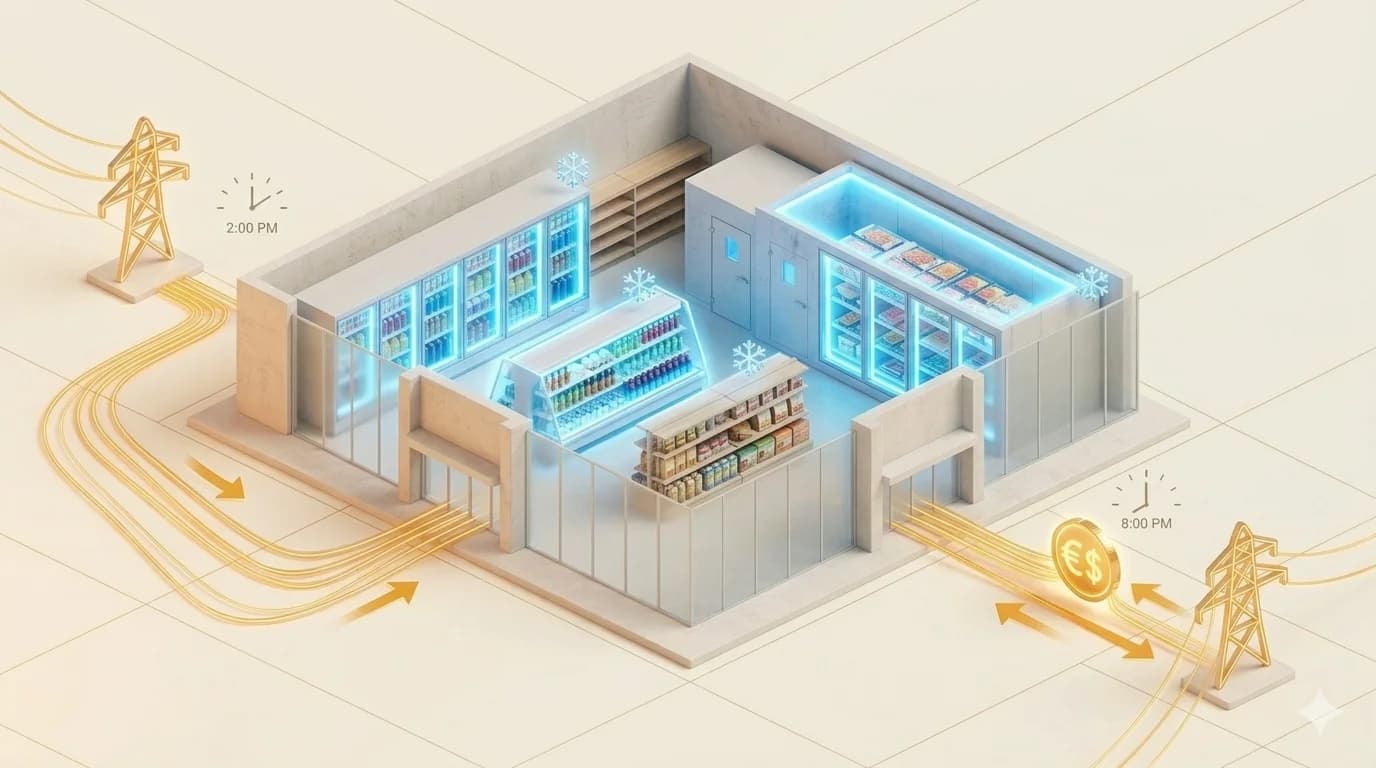
Every supermarket has a battery hidden in plain sight. It's not in a container out back. It's in your display cases, your walk-in freezers, your cold rooms. Thousands of frozen products holding cold energy that can be released on demand.
Turn off the compressors and nothing dramatic happens. Temperatures rise slowly. You have 20 to 90 minutes before anything gets close to a safety threshold. That window is worth money. Real money. Flexibility markets will pay you to pause your refrigeration when the grid needs relief.
Over 120 7-Eleven stores in the US are already earning revenue this way. The question isn't whether your refrigeration can do it. It's why you haven't started yet.
Key Takeaways
Refrigeration represents 40-50% of supermarket electricity, making it the largest flexibility asset in the building (ScienceDirect, 2025)
Walk-in freezers rise only 2.4°F per hour when compressors stop, leaving plenty of margin for demand response (NREL, 2022)
Flexibility markets pay $30,000-$85,000 per MW/year; Europe's C&I opportunity is EUR 8 billion (McKinsey, 2024)
Thermal storage costs $232/kWh vs $304/kWh for lithium-ion, with 2x the lifespan (BNEF, 2024)
Why Is Refrigeration the Perfect Flexibility Asset?
A typical supermarket dedicates 40 to 50% of its total electricity consumption to refrigeration, with one Spanish study measuring exactly 49.55% (ScienceDirect, 2025). That's not just a cost. It's an opportunity. No other load in the building is simultaneously this large, this flexible, and this forgiving of short interruptions.
Why does refrigeration work so well for flexibility? Because the products themselves store cold. A walk-in freezer full of frozen goods at -20°C holds enormous thermal energy. When you pause the compressor, the products release their stored cold gradually. Temperatures rise slowly, predictably, and within safe limits for extended periods.
Research confirms that supermarkets can flex 60 to 80% of their normal cooling capacity for around 20 minutes without any food safety impact (IEEE/Danfoss, 2016). For grid frequency response, they can even react within 5 to 10 seconds. That's faster than most chemical batteries.
Our finding: Across the supermarket portfolios we monitor, refrigeration consistently represents the single largest controllable load, and the one with the most untapped flexibility value, typically worth 3 to 5x more in flexibility revenue than the energy cost savings from basic load shifting alone.
What Happens to Food When You Turn Off the Compressors?
This is the question every operator asks first, and the data is reassuring. The NREL conducted a pilot study in a 45,590 sq ft supermarket in Hillsboro, Oregon, measuring exactly how fast temperatures rise when compressors shut down. Walk-in freezers gained just 0.04°F per minute, or 2.4°F per hour. Frozen food display cases rose faster at 0.16°F per minute, but still within safe margins for 15 to 30 minutes of curtailment (NREL, 2022).
The strategy that unlocks even more flexibility? Pre-cooling. Before a demand response event, you cool your cases 2 to 3°F below the normal setpoint. This extends the coast period significantly, from 20 minutes to 60 or even 90 minutes, without ever approaching food safety thresholds.
Cold thermal energy storage systems take this further. A peer-reviewed MDPI study found that CTES in supermarket CO2 refrigeration systems achieved peak power reduction of up to 32.33% and energy savings of 11.8% (MDPI Energies, 2024). The cold you store during cheap off-peak hours becomes the buffer that earns you money during peak demand.
What about frozen food safety? The FDA mandates that frozen products stay below 0°F (-18°C). Starting from a typical setpoint of -10°F to -15°F, a walk-in freezer has 4 to 6 hours of thermal coast before hitting the safety threshold. Even display cases have 30 to 60 minutes. Demand response events rarely last more than 20 to 30 minutes. The math works comfortably.
From our experience: In every supermarket we've onboarded for flexibility programs, the initial fear is always food safety. After the first demand response event, where operators watch temperatures rise by just 1-2°F before compressors restart, that fear disappears. The thermal mass of frozen products is far more resilient than people expect.
How Much Can Supermarkets Earn From Flexibility?
This is where it gets interesting. Flexibility markets across the US, UK, and Europe are paying significant premiums for demand-side response, and supermarket refrigeration is one of the highest-value assets in those markets.
Example: A 10-store supermarket chain in PJM
300 kW of flexible refrigeration per store x 10 stores = 3 MW total capacity. At $73,000/MW/year guaranteed, that's $219,000 in annual flexibility revenue. Enough to fund a full store renovation every two years, generated by equipment that's already running.
In the US PJM market, GridBeyond and Constellation now offer a guaranteed floor of $73,000 per MW per year for up to 10 years, with 100% revenue share (GridBeyond/Constellation, 2025). For a mid-size supermarket with 200-500 kW of flexible refrigeration capacity, that translates to $14,600 to $36,500 per year in guaranteed income, just for agreeing to reduce load when asked.
The numbers are compelling in Europe too. McKinsey estimates that EUR 8 billion in flexibility value is accessible to commercial and industrial players across Europe, and only a small share is currently captured (McKinsey, 2024). In France, RTE contracted up to 2,900 MW of demand response capacity in 2025, targeting 6.5 GW by 2028 and 10 GW by 2030 (RTE France, 2024). Over 90% of flexibility operator revenue comes from capacity payments: reliable, predictable income.
When Giant Eagle's energy team in Pennsylvania broke down their electric bill, they found a surprise: capacity charges made up a full 25% of the total. A quarter of their energy budget, gone to peak demand penalties. They connected their existing Danfoss compressor controllers to PJM's demand response market. What had been their biggest cost headache became a recurring revenue check. Today, their refrigeration systems earn money every time the grid needs relief (Danfoss, 2023).
The UK flexibility market contracted 9 GW of capacity in 2024, delivering GBP 300 million in consumer savings, with total flexibility capacity projected to reach 55.2 GW by 2030 (Electron, 2025). The demand response market globally is valued at $42.5 billion and growing at 12.5% CAGR (IndustryARC, 2024). This isn't a niche pilot program anymore. It's a mainstream revenue stream.
Thermal Battery vs. Lithium-Ion: Which Makes More Sense?
When people hear "battery storage for demand response," they think lithium-ion. Expensive racks of cells in a container behind the building. But supermarket operators already have a better option, and it's cheaper.
Thermal energy storage averages $232 per kWh installed, compared to $304 per kWh for a 4-hour lithium-ion system, 24% cheaper (BNEF, 2024). But cost per kWh is just the beginning. The real advantages stack up across every dimension that matters.
Viking Cold Solutions demonstrated this at scale in a 93,000 sq ft warehouse. Their thermal energy storage system reduced energy consumption by 43%, cut peak demand by 29%, and shifted the entire daily peak demand outside a 13-hour peak pricing window, achieving 300 to 400 kW of demand reduction sustained for the full 13 hours (Viking Cold Solutions, 2023). Try getting 13 hours of sustained discharge from a lithium-ion battery at a comparable price.
The real insight: The biggest advantage of refrigeration-based flexibility isn't the cost per kWh. It's the marginal cost. You already own the refrigerators. You already pay for the electricity. The incremental investment is just smart controllers and an aggregator contract. There's no $304/kWh capital expense like lithium-ion. The battery is already in your store.
The thermal battery payback period dropped to 4.2 years in 2024, and that's for purpose-built TES systems (BNEF, 2024). For existing refrigeration that simply needs smart controls? Payback can be under 12 months because you're not buying storage capacity. You're monetizing what you already have.
Getting refrigeration flexibility revenue isn't a science project. Hundreds of supermarkets across the US, UK, and France are already doing it. Here's the practical path.
Step 1: Measure your flexibility potential. Install submetering on your refrigeration circuits if you don't have it already. You need to know how many kW of compressor load you're running at peak, and how that load varies by time of day and season. Most supermarkets discover they have 150 to 500 kW of flexible capacity.
Step 2: Choose an aggregator. You don't participate in flexibility markets directly. An aggregator handles the market interface. Companies like GridBeyond, Enel, Voltalis, or Flexcity (in France) bundle your flexibility with other sites to meet minimum MW thresholds. They handle bidding, dispatch, and settlement.
Step 3: Install smart controllers. Danfoss, Emerson, and others make controllers that interface with your existing compressor racks. They receive curtailment signals from the aggregator and manage the compressor shutdown and restart sequence automatically. Installation typically takes one to two days per store.
Step 4: Configure pre-cooling. Set your systems to cool 2 to 3°F below setpoint in the hour before typical demand response windows. This extends your curtailment duration and protects food safety margins.
Step 5: Start earning. Once enrolled, you receive capacity payments (regular monthly income) plus event-based payments when you actually curtail. Most programs require availability during peak hours, typically 4 to 8 PM on weekdays. The rest of the time, your refrigeration runs normally.
A grocery store study found that demand response participation yields 5 to 13% annual savings on total energy costs (ScienceDirect, 2025). That's on top of the flexibility revenue. Pre-cooling during cheap off-peak hours and coasting during expensive peaks is just good economics.
Our portfolio consumption analysis can help you benchmark your stores against peers and identify which sites have the most flexibility headroom.
Frequently Asked Questions
How long can supermarket refrigeration be turned off during demand response?
Walk-in freezers can safely coast for 60 to 90 minutes with pre-cooling, rising only 2.4°F per hour (NREL, 2022). Display cases have shorter windows of 15 to 30 minutes. Most demand response events last 20 to 30 minutes, well within safe limits.
What happens if a demand response event is called during peak shopping hours?
Smart controllers prioritize customer-facing cases, shed back-of-house loads first. Display case temperatures stay stable while walk-in freezers coast. Shoppers never notice.
Do I need to replace my existing refrigeration controllers?
No. Most aggregator programs work with Danfoss, Emerson, and other major controller brands already installed. The integration is software-side. Your existing hardware stays in place.
What if my store is too small to participate?
Aggregators bundle multiple sites. Even a single restaurant with 50 kW of refrigeration can participate through an aggregator pool. The aggregator combines your capacity with other sites to meet minimum MW thresholds required by grid operators.
What is the difference between demand response and load shifting?
Demand response means reducing consumption when the grid asks, and you earn revenue for availability and actual curtailment. Load shifting means moving consumption to cheaper hours proactively, saving money on your own bill. Both use the same thermal inertia. See our load shifting strategies guide for more on the savings side.
Your Fridges Are Already a Battery. Start Monetizing Them
France is targeting 10 GW of demand response by 2030. The UK projects 55.2 GW of flexibility capacity. The supermarkets enrolling now are locking in 10-year guaranteed contracts at $73,000 per MW. The ones waiting are leaving that revenue on the table every year they delay.
The battery is already in your store. Every display case, every walk-in freezer, every compressor rack. The only question is whether you'll be the one who monetizes it, or whether your competitors will get there first.