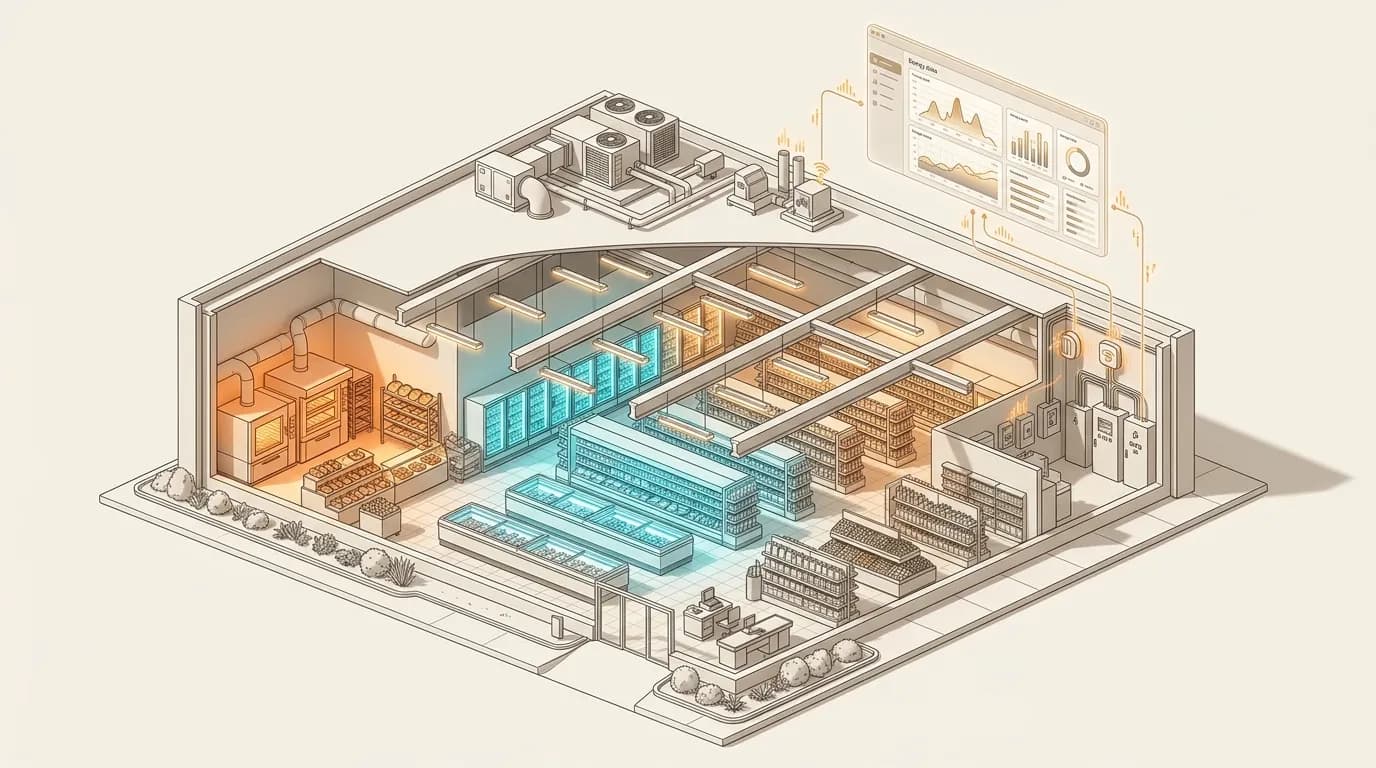
Energy Monitoring for Supermarkets: The Complete Guide
It's 6:47 AM on a Tuesday. The store manager at a mid-sized supermarket in Lyon walks in to open up. Everything looks normal. The lights are on, the shelves are stocked, the bakery ovens are warming. But overnight, a compressor on aisle seven's frozen display case started cycling erratically. Nobody noticed. By the time the maintenance team spots the issue three weeks later, that single fault has cost the store over 2,000 euros in wasted electricity and spoiled product.
This story plays out in supermarkets across Europe every single day. Not because operators don't care about energy. Because they can't see what's happening.
Key Takeaways
- Refrigeration consumes 40-60% of a supermarket's total electricity, making it the single largest savings lever (ScienceDirect, 2025)
- Energy monitoring systems deliver 10-25% savings with payback under 18 months (ACEEE, 2025)
- A 10% energy cut can boost net profit margins by up to 16% for a typical supermarket
- France's Decret Tertiaire mandates -40% energy consumption by 2030 for stores over 1,000 m²
- Automated fault detection cuts refrigeration repair costs by up to 75% (Energy Informatics, 2024)
- Multi-site benchmarking reveals best-in-class stores can achieve 140 kWh/m² annually
How Much Energy Does a Supermarket Actually Use?
A convenience store at 1,200 kWh/m² uses roughly three times more energy per square metre than a well-optimized hypermarket at 400 kWh/m². Best-in-class facilities push below 140 kWh/m². Where does your store sit on that spectrum?
Understanding this breakdown is the first step. But without continuous monitoring, you're relying on monthly utility bills that arrive weeks late. By then, the damage is done.
Why Is Refrigeration Monitoring the Highest Priority?
The challenge? Refrigeration problems are silent. A compressor losing efficiency doesn't trigger an alarm. A door gasket degrading doesn't flash a warning light. Temperature drift of half a degree per week goes unnoticed until food safety is compromised.
What Does Anomaly Detection Actually Catch?
Here's what continuous refrigeration monitoring typically catches:
- Compressor short-cycling: running too frequently, wearing out faster, using more energy
- Temperature drift: slow, steady increases that indicate seal failures or refrigerant leaks
- Defrost irregularities: cycles running too long or too often, wasting energy
- Condenser fouling: reduced heat exchange driving up energy consumption by 15 to 20%
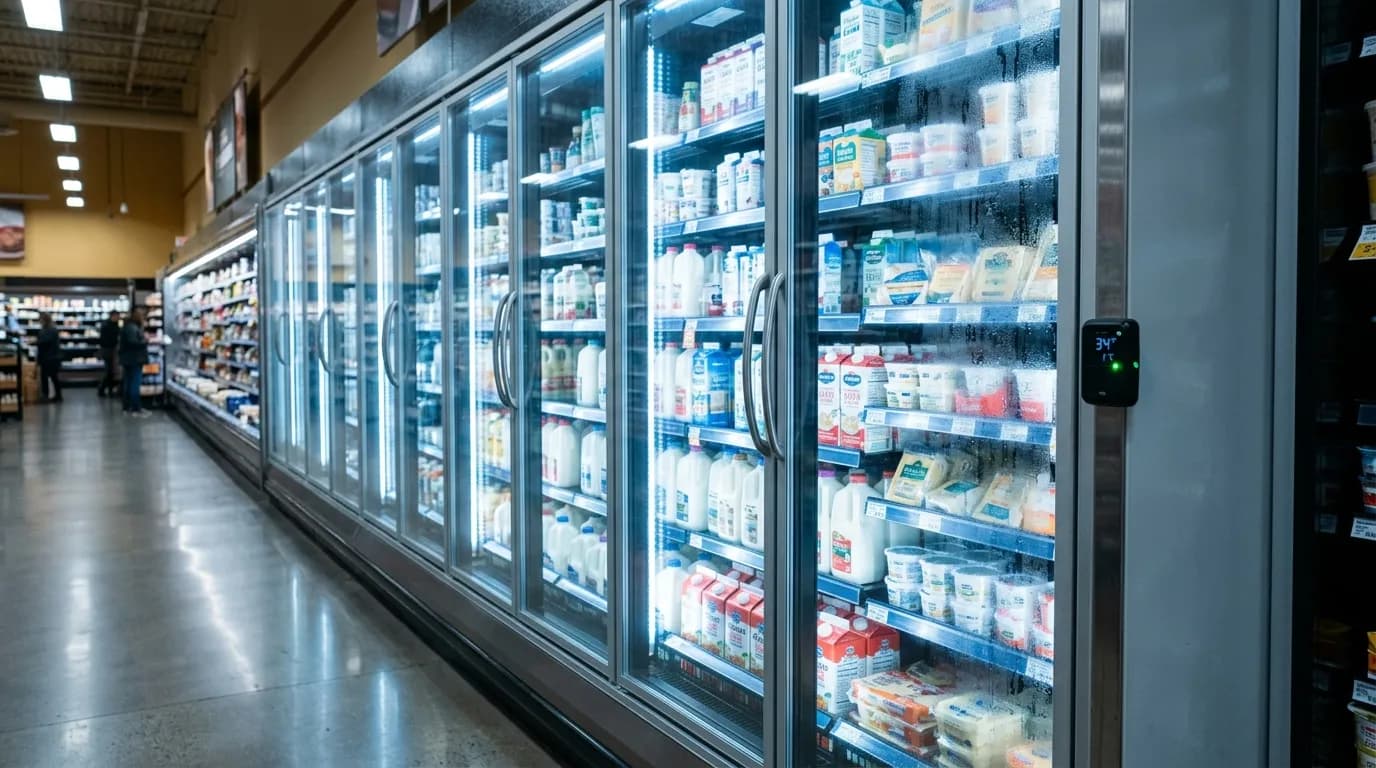
Our finding: Across the supermarket portfolios we monitor, refrigeration faults detected within 24 hours cost an average of 180 euros to resolve. The same faults detected after three weeks cost over 2,400 euros, factoring in wasted energy, spoiled inventory, and emergency repair callouts.
What ROI Should Supermarkets Expect From Energy Monitoring?
Let's do the maths. A mid-sized supermarket spends approximately 150,000 euros per year on electricity. A 15% reduction saves 22,500 euros annually. With monitoring system costs typically between 15,000 and 30,000 euros for installation and the first year, payback happens within 12 to 18 months.
How Does HVAC Optimization Work in Supermarkets?
HVAC accounts for 10 to 15% of supermarket energy consumption, but its behaviour is uniquely complex in retail environments. Unlike an office building, a supermarket has open refrigerated cases that constantly fight the ambient air. The HVAC and refrigeration systems interact constantly, and optimizing one without understanding the other leaves savings on the table.
The key insight is matching HVAC output to actual conditions rather than fixed schedules. Foot traffic varies dramatically throughout the day. A store that's nearly empty at 8 AM doesn't need the same cooling as at 5 PM during the evening rush. Outdoor temperature swings between seasons change cooling loads by 30 to 50%.
Smart HVAC Scheduling Strategies
Three approaches consistently deliver results in supermarkets:
Our finding: Supermarkets that align HVAC schedules to both foot traffic patterns and outdoor temperature data reduce their HVAC energy by 18 to 22%, compared to 8 to 12% from schedule-based optimization alone.
Why Is Lighting Still a Major Savings Opportunity?
A supermarket that opens at 7 AM doesn't need full lighting intensity until customers arrive. Stocking hours require enough light for safety, not the same levels needed for the sales floor during peak hours. Yet most stores run at 100% from the moment the first light switches on.
What Does Smart Lighting Look Like?
Daylight harvesting uses sensors near windows and skylights to dim artificial lighting when natural light is sufficient. In stores with significant glazing, this can reduce lighting energy by 20 to 30%.
Zone-based scheduling divides the store into areas with different lighting needs. The warehouse doesn't need the same intensity as the produce section. Aisles without customers can dim to 60% without anyone noticing.
Motion-triggered lighting in back-of-house areas like stockrooms, offices, and loading docks eliminates the "lights left on all night" problem that plagues most stores.
How Should Bakery and Cooking Equipment Be Managed?
Bakery and cooking equipment accounts for 5 to 10% of supermarket energy, but it's concentrated in short, intense bursts. A bank of deck ovens drawing 50 kW for four hours every morning creates a significant peak demand charge.
The strategy here isn't about using less energy. It's about using it at the right time. Staggering oven start-up times across 30-minute intervals instead of firing everything simultaneously can reduce peak demand by 15 to 25%. That directly lowers demand charges, which can represent 30 to 40% of a commercial electricity bill.
Monitoring also catches equipment left running after production ends. A proofer that should shut down at 10 AM but runs until closing time wastes energy every single day it goes undetected. How many of your stores have equipment running longer than it should?
Our finding: In our analysis of bakery energy profiles across supermarket portfolios, 35% of stores had at least one piece of cooking equipment running 2 or more hours beyond its planned schedule, adding 3 to 5% to the store's total energy bill.
What's Better: Real-Time Alerts or Periodic Energy Audits?
A traditional energy audit provides a snapshot. It's valuable for identifying major inefficiencies and planning capital investments. But it can't detect a compressor that starts failing on a Wednesday at 3 AM. It can't spot a door gasket that degraded gradually over six months. It can't tell you that Store 47 suddenly started using 18% more energy than Store 48 next door.
How Does Multi-Site Benchmarking Transform Retail Chains?
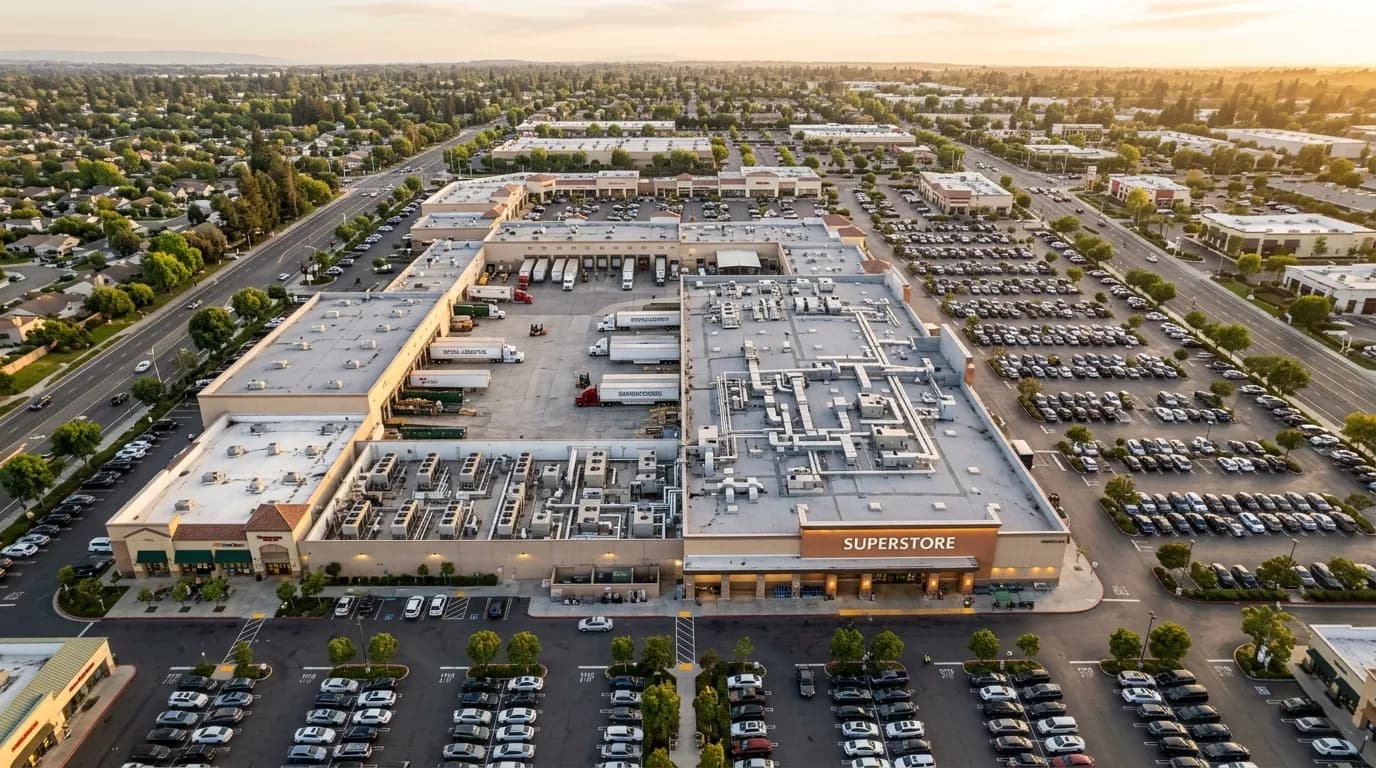
When you compare Store A to Store B, both running similar formats in similar climates, differences in energy consumption per square metre immediately highlight operational issues. Is Store A's refrigeration using 30% more energy? Perhaps a condenser needs cleaning. Is Store B's HVAC running during closed hours? That's a scheduling error.
The Power of Normalised Comparison
Raw kWh comparisons between sites are misleading. A 3,000 m² store will naturally use more than a 1,500 m² store. Climate matters. Operating hours matter. Product mix matters. Effective benchmarking normalises for all of these variables.
The metrics that matter most for multi-site supermarket benchmarking:
- kWh/m²/year for overall efficiency comparison
- kWh per linear metre of refrigerated display for refrigeration efficiency
- Energy per transaction for linking consumption to commercial activity
- Deviation from predicted baseline for catching anomalies relative to each store's own normal
Our finding: When retail chains first deploy cross-site benchmarking, the bottom 20% of stores typically show consumption 25 to 40% above the chain average. Bringing those outliers to the median performance level usually represents the fastest payback of any energy initiative.
What About Compliance? Understanding the Decret Tertiaire for Retail
What Does Compliance Require in Practice?
Energy monitoring directly supports compliance in three ways:
- Baseline establishment. Accurate historical data defines your reference consumption, which determines your reduction targets.
- Progress tracking. Continuous monitoring shows whether you're on trajectory or falling behind, before the annual reporting deadline.
- Evidence documentation. Automated data collection generates the audit trail needed for OPERAT submissions.
Without monitoring, compliance becomes a reactive scramble every September. With monitoring, it's a continuous process integrated into daily operations. Which approach sounds more sustainable for a 50-store chain?
How Should You Set Up Supermarket Energy Monitoring?
Implementation follows a clear sequence. Rushing to install sensors everywhere creates data overload. A phased approach delivers faster ROI and builds internal confidence.
Phase 1: Refrigeration First (Months 1-3)
Start with refrigeration because it's the biggest load and the most likely source of hidden waste. Install IoT sensors on:
- Compressor racks (electrical sub-metering, discharge temperature, suction pressure)
- Display case temperatures (supply air, return air, product simulation probes)
- Cold room temperatures and door contacts
- Condenser inlet and outlet temperatures
Configure alerts for temperature deviations, unusual compressor cycling, and energy consumption above baseline. This phase alone typically delivers 5 to 10% of total store energy savings.
Phase 2: HVAC and Lighting (Months 3-6)
Add monitoring to HVAC systems and lighting circuits. Integrate with any existing building management system. Begin correlating HVAC consumption with outdoor temperature, foot traffic, and refrigeration heat rejection.
For lighting, sub-meter by zone if possible. Track total lighting hours versus scheduled hours. Identify zones where lights run unnecessarily.
Phase 3: Full Integration and Benchmarking (Months 6-12)
Connect bakery and cooking equipment. Integrate POS data for energy-per-transaction metrics. Begin multi-site benchmarking if operating more than one location. Deploy predictive maintenance algorithms that learn each store's normal patterns.
Phase 4: Optimisation and Flexibility (Ongoing)
What Questions Do Supermarket Operators Ask Most?
How much does supermarket energy monitoring cost to install?
For a single store, expect 10,000 to 30,000 euros for hardware, installation, and the first year of platform fees, depending on store size and the number of monitored systems. IoT sensor packages for refrigeration monitoring start at the lower end. Full-store monitoring with HVAC, lighting, and bakery sub-metering sits at the higher end. Multi-site deployments benefit from volume pricing that can reduce per-store costs by 20 to 40%. Payback typically occurs within 12 to 18 months.
Can energy monitoring really prevent food spoilage?
Yes. Continuous temperature monitoring with real-time alerts catches refrigeration failures within minutes rather than hours or days. Traditional walk-through temperature checks happen two to four times per day, leaving long gaps where failures go undetected. A walk-in freezer that loses power at 11 PM won't be noticed until the morning shift, potentially spoiling thousands of euros in product. Monitoring systems send immediate alerts to the on-call technician, who can respond before temperatures reach critical thresholds.
Is the Decret Tertiaire mandatory for all supermarkets in France?
How long does it take to see results from energy monitoring?
Most supermarkets see measurable results within the first 90 days. The initial gains come from identifying and fixing obvious issues like equipment running outside scheduled hours, faulty sensors, and poorly configured setpoints. Deeper savings from optimized scheduling, predictive maintenance, and multi-site benchmarking develop over months 3 to 12. The savings curve is steepest in the first year, then stabilizes at a sustained level as the major inefficiencies are resolved and continuous improvement takes over.
Does energy monitoring work with existing building management systems?
Modern monitoring platforms integrate with most existing BMS infrastructure through standard protocols like BACnet, Modbus, and MQTT. You don't need to rip out your existing systems. IoT sensor overlays can supplement older BMS installations that lack granular sub-metering, adding refrigeration and equipment-level data without replacing the core infrastructure.
Ready to See What Your Supermarkets Are Really Using?
Energy monitoring for supermarkets isn't a technology experiment. It's a proven operational strategy that pays for itself within 18 months and keeps delivering savings year after year.
The numbers are clear. Refrigeration alone offers 40 to 60% of total savings potential. Multi-site benchmarking reveals hidden waste across your portfolio. And with the Decret Tertiaire's 2030 deadline approaching fast, the compliance case is just as strong as the financial one.
Whether you operate one store or one hundred, the first step is the same: make your energy consumption visible. From there, every decision gets better.