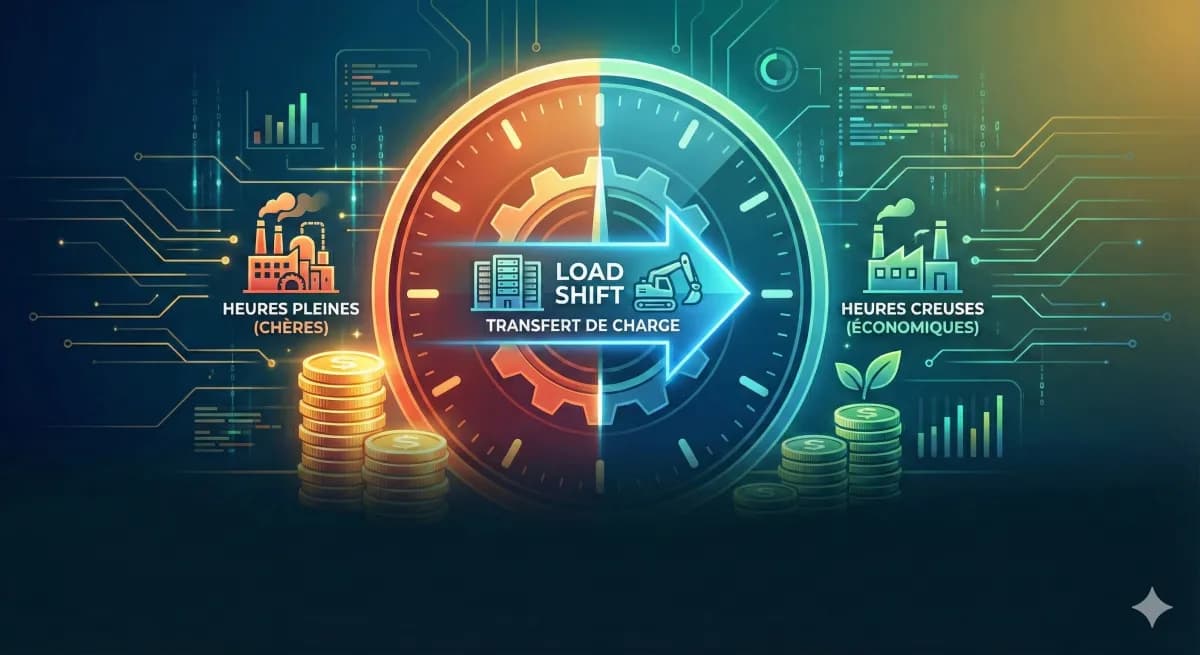
Load Shifting: 6 Strategies to Reduce Your Energy Costs
Key Takeaways
- Load shifting reduces peak demand by 20-40% and CO2 emissions by up to 30% (Frontiers in Energy Research, 2026)
- Refrigeration pre-cooling alone can save 5-13% on annual energy costs
- Simple measures like charging timers pay back in 3-6 months
- No consumption reduction required, just smarter scheduling
- France's off-peak hours are expanding in 2027 to include solar afternoon windows
Why Does Electricity Cost More During Peak Hours?
What Are the 6 Best Load Shifting Strategies?
1. Pre-Cooling Refrigeration Systems
2. Equipment Charging During Off-Peak Hours
Why pay peak rates for something that can run at night? Forklifts, floor scrubbers, and electric pallet jacks all accept scheduled charging without any operational compromise.
The idea: install timers or smart charging stations that restrict charging to off-peak windows. It's one of the simplest load-shifting measures. No temperature risks. No complex controls. Just a timer and some discipline.
- Forklifts and electric pallet jacks
- Floor scrubbers and cleaning machines
- Battery backup systems
- Electric vehicle fleet chargers
3. HVAC Pre-Conditioning
Buildings are thermal batteries. Concrete slabs, walls, and insulation hold temperature for hours. Why not charge that battery when electricity is cheap?
4. Domestic Hot Water Scheduling
Hot water storage is one of the oldest forms of energy shifting. And it still works beautifully. Heat water exclusively during off-peak hours and store it in well-insulated tanks.
- Install larger storage tanks to cover daytime demand
- Program water heaters to run from 10 PM to 6 AM only
- Improve tank insulation to minimize standby losses
- Schedule intensive cleaning during off-peak hours
5. Ice Storage Systems
Ice storage takes load shifting to another level. Produce and store ice during off-peak hours, then use it for cooling during peak periods. Large facilities, especially food processing plants and some commercial kitchens, see dramatic savings.
- Ice machines run overnight at off-peak rates
- Storage capacity sized for full daytime cooling needs
- Melt ice replaces or supplements mechanical cooling during peak hours
6. Lighting and Auxiliary Systems
These are smaller wins individually, but they add up. And they're often the easiest to implement.
- Outdoor and parking lot lighting on timers
- Cleaning operations scheduled during off-peak hours
- Advertising signs on automated schedules
- Motion detectors in non-public areas (stockrooms, corridors)
How Do These Strategies Compare?
Each strategy differs in savings potential, upfront cost, and implementation complexity. Here's a practical comparison based on typical commercial sites.
| Strategy | Savings Range | Investment | Complexity | Typical ROI |
|---|---|---|---|---|
| Refrigeration pre-cooling | 15-25% on refrigeration | 3,000-8,000 EUR | Medium | 6-12 months |
| Equipment charging | 60-70% on charging | 1,000-5,000 EUR | Low | 3-6 months |
| HVAC pre-conditioning | 20-35% on HVAC | 5,000-15,000 EUR | Medium | 12-18 months |
| Hot water scheduling | 50-65% on water heating | 2,000-6,000 EUR | Low | 6-12 months |
| Ice storage | 50-70% on ice/cooling | 15,000-50,000 EUR | High | 18-36 months |
| Lighting and auxiliaries | 10-20% on lighting | 500-3,000 EUR | Low | 3-6 months |
In our experience, the best approach is to start with equipment charging and hot water, the two lowest-complexity strategies. They fund the more ambitious projects like refrigeration pre-cooling and ice storage.
How Do You Implement Load Shifting Step by Step?
Step 1: Analyze Your Consumption
Before shifting anything, you need visibility. Where does your energy go, and when?
- Map hourly consumption peaks across a full billing cycle
- Identify which equipment is flexible (can shift without operational impact)
- Review your tariff structure for peak/off-peak differentials
- Install sub-meters on major loads if you don't have them
Step 2: Prioritize by ROI
Start where the returns are fastest:
- Equipment charging (easy, immediate ROI)
- Hot water scheduling (low cost, high return)
- Refrigeration pre-cooling (highest absolute savings potential)
- HVAC pre-conditioning (depends on building thermal mass)
Step 3: Automate Everything
Manual load shifting doesn't last. People forget. Schedules slip. Invest in automation.
- Programmable thermostats: 150-400 EUR per unit
- Charging timers: 50-200 EUR per unit
- Building management system: 10,000-150,000 EUR depending on scale
Step 4: Monitor and Safeguard
Automation without monitoring is a risk. Especially for food safety.
- Temperature monitoring with real-time alarms
- Backup systems for critical refrigeration
- Staff training on protocols and override procedures
- Full compliance with food safety standards, including HACCP requirements (EU Regulation 852/2004)
What Results Can You Expect in Practice?
Mid-Size Supermarket (3,000 m2)
One of our clients, a 3,000 m2 supermarket in France, implemented four strategies simultaneously.
- Refrigeration pre-cooling with programmable controls
- Off-peak forklift and equipment charging
- HVAC pre-conditioning using building thermal mass
- Scheduled hot water heating
Logistics Warehouse (15,000 m2)
A larger project with a full building management system installation.
- Complete BMS with automated scheduling
- Thermal energy storage system
- Smart charging for 40 forklifts
- Lighting and equipment optimization
What About ESG and Sustainability Benefits?
- CO2 emission reduction: 30-50 tonnes per year for 200 MWh shifted
- Grid stabilization through peak demand reduction
- Support for renewable energy integration (consuming when solar and wind are abundant)
- Quantifiable energy efficiency improvement (kWh shifted, not just saved)
- Reduced carbon footprint with auditable data
- Contribution to grid resilience, a growing metric in sustainability frameworks
Most companies think of load shifting purely as a cost measure. But it's increasingly becoming an ESG differentiator. We've seen procurement teams from major retailers ask suppliers about demand flexibility practices as part of sustainability audits.
What Advanced Technologies Are Available?
Several technologies are expanding what's possible with load shifting. The economics keep improving.
Battery Energy Storage Systems (BESS)
Demand Response Programs
AI-Powered Optimization
Next-generation building management systems use machine learning to predict demand based on weather, occupancy, and pricing signals. They adjust automatically in real time. In our experience, these systems deliver an additional 10-15% savings on top of manual scheduling.
Frequently Asked Questions
Does load shifting affect product quality or food safety?
What is the typical return on investment?
Can load shifting work for any building type?
Yes. Supermarkets, logistics warehouses, offices, hotels, and manufacturing facilities all benefit. The approach adapts to each sector's consumption profile. Refrigeration-heavy sites like supermarkets see the largest percentage gains, while warehouses with large forklift fleets benefit most from charging optimization.
What if our energy supplier doesn't offer peak/off-peak pricing?
Do we need specialized technical expertise?
Not to start. Begin with timers and programmable thermostats. These require minimal technical knowledge. For more complex systems like BMS installations or BESS, work with energy management specialists. Many offer performance-based contracts tied to actual savings achieved, reducing your upfront risk.
Conclusion
- Start with quick-ROI measures: equipment charging and hot water scheduling
- Automate with programmable controls to ensure consistency
- Monitor with real-time alarms, especially for food safety compliance
- Reinvest early savings into higher-impact strategies like pre-cooling and BESS
With France's off-peak hours expanding in 2027 and BESS costs declining sharply, the business case for load shifting only gets stronger. The question isn't whether to start. It's how quickly you can move.