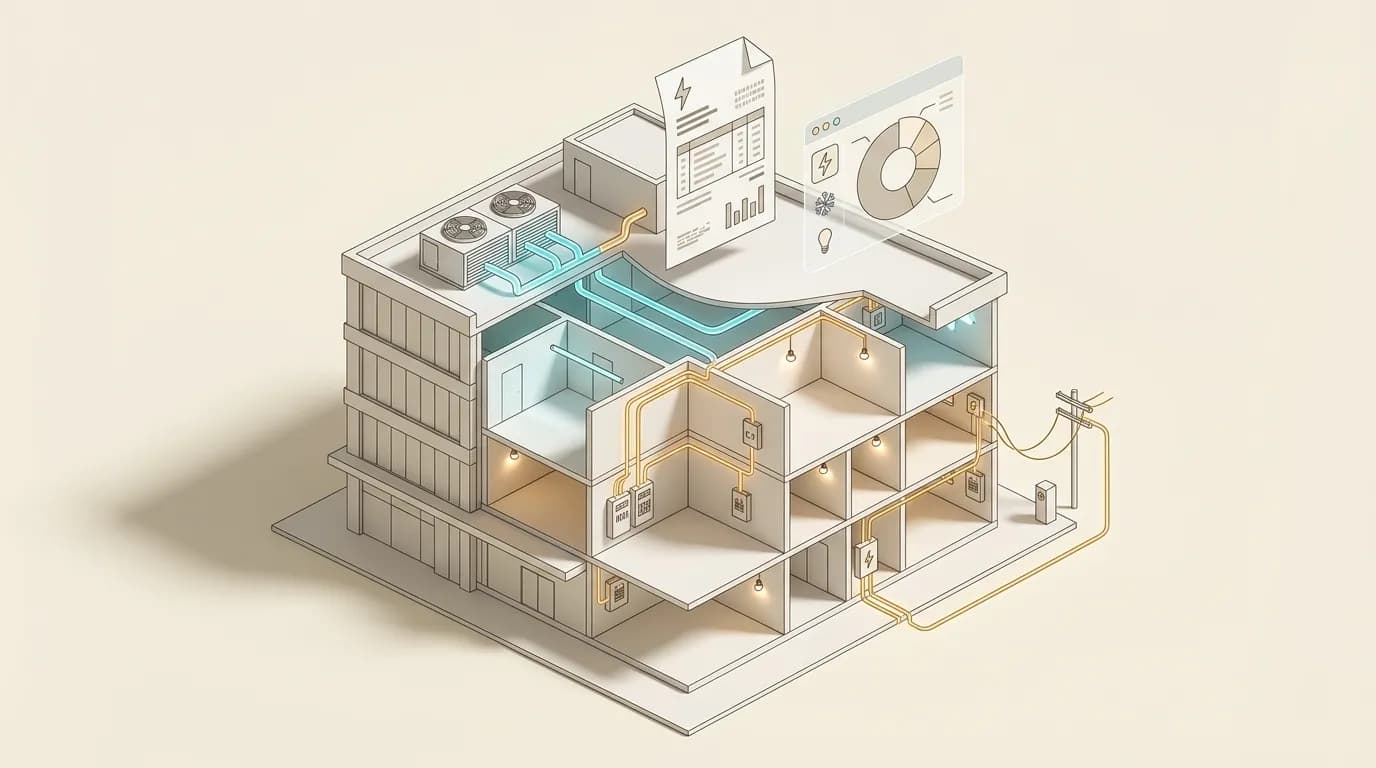
How to Read Your Commercial Electricity Bill (and Find Hidden Costs)
Last quarter, a supermarket chain we work with discovered they'd been paying for a demand tier they hadn't exceeded in two years. Nobody had checked. The overcharge amounted to over 14,000 euros annually, buried inside a 30-page PDF that arrived every month like clockwork. The finance team paid it. Every single time.
The problem isn't dishonesty. It's complexity. Commercial electricity bills are dense, jargon-heavy documents designed for utility accountants. Not for the people who actually pay them.
Key Takeaways
- Demand charges alone can represent 30-70% of a commercial electricity bill (Clean Energy Group)
- Taxes and levies account for 25-40% of commercial electricity prices in the EU (Eurostat, 2025)
- Reactive power penalties hit businesses with power factors below 0.92-0.95, adding up to 10-15% to costs
- Tariff selection alone can save 5-15% without changing a single piece of equipment
- Up to 30% of energy consumed in commercial buildings is wasted, much of it outside operating hours (Energy Star)
What Are the Main Components of a Commercial Electricity Bill?
The Energy Supply Charge
This is the part most people understand. You consumed a certain number of kilowatt-hours, and your supplier charges a rate per kWh. Simple enough. But even here, complexities hide. Multi-period tariffs split consumption into peak, off-peak, and sometimes shoulder periods. The rate difference between peak and off-peak can reach 40-60%.
If you're on the wrong tariff structure for your consumption profile, you're leaking money every month. We'll get to tariff optimization later.
The Demand Charge (Peak Power)
This is where most businesses get surprised. The demand charge isn't about how much energy you used. It's about how much power you drew at your highest moment. Think of it as paying for the size of the pipe, not just the water flowing through it.
Network Charges (TURPE in France)
Taxes and Levies
Our finding: Across the commercial portfolios we monitor, taxes and network charges together typically represent 45-55% of the total bill. The "energy" portion that most managers focus on is actually the minority share.
How Do Demand Charges Actually Work?
Your meter records your power draw in kilowatts (kW) every 15 minutes throughout the billing period. The single highest 15-minute average becomes your "peak demand" for that month. You pay a rate per kW for that peak, regardless of whether it happened once or a hundred times.
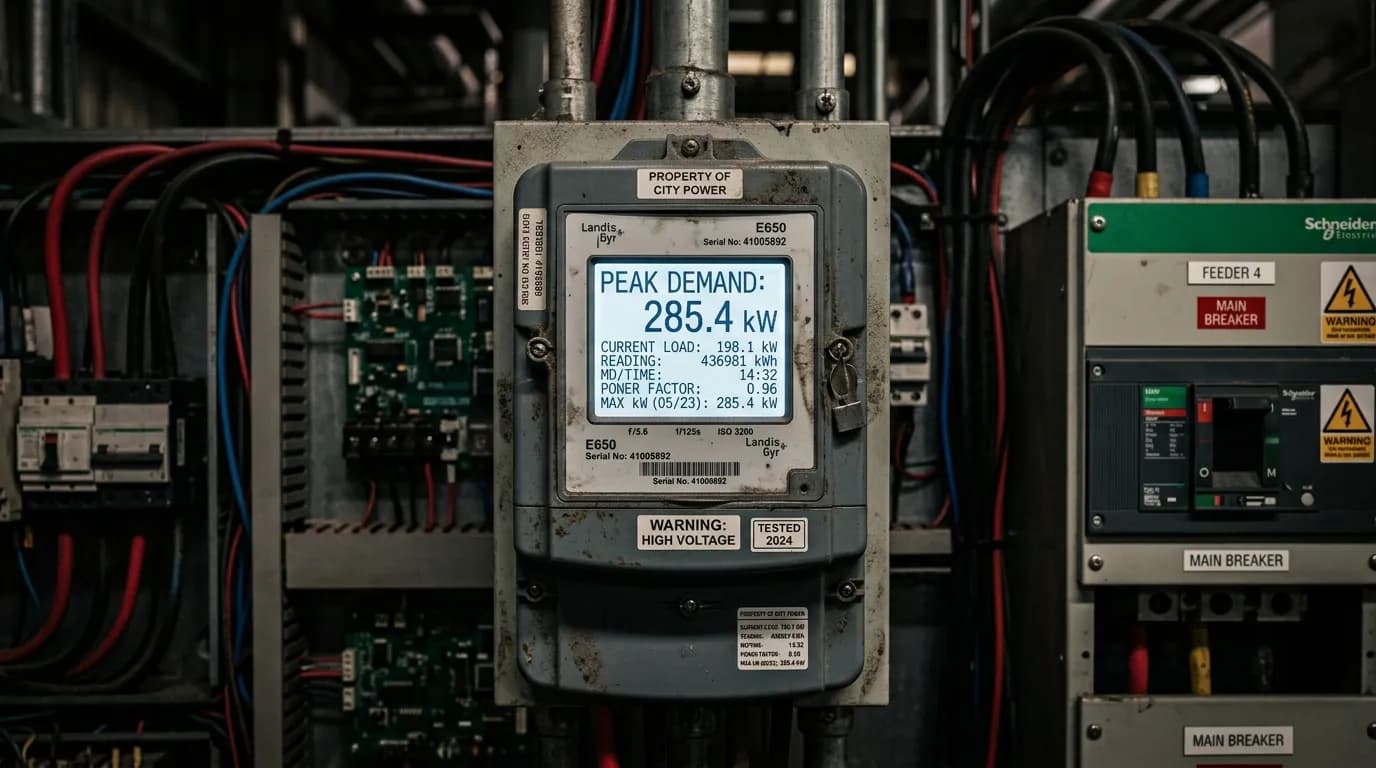
Why does this matter so much? Because a single spike can inflate your bill for the entire month.
The Peak Demand Trap
Imagine a bakery inside a supermarket. At 5 AM, the ovens fire up. The refrigeration compressors cycle on. The HVAC system starts pre-cooling the store. For fifteen minutes, every major load runs simultaneously. That one quarter-hour sets the demand charge for the next 30 days.
Subscribed Demand vs. Measured Demand
In France and several other European markets, commercial contracts include a "subscribed demand" (puissance souscrite). You choose a demand tier when signing your contract. Go over it, and you pay steep overage penalties. Stay well below it, and you're paying for capacity you never use.
Our finding: When we audit client contracts, roughly 40% have a subscribed demand that doesn't match their actual consumption pattern. About half are over-subscribed (paying for unused capacity), and half are under-subscribed (paying overage penalties regularly).
Checking your subscribed demand against your actual peak demand is one of the simplest savings opportunities in energy management. It costs nothing to adjust. Yet most businesses haven't reviewed theirs in years.
What Is the Reactive Power Penalty on Your Bill?
But what is reactive power, exactly? Not all electricity does useful work. Motors, compressors, and transformers draw "reactive" power to maintain their magnetic fields. This reactive power travels back and forth on the grid without producing useful output. Your meter records it separately, and you get charged for it.
Who Gets Hit Hardest?
Supermarkets and logistics warehouses are prime candidates. Their refrigeration systems run continuously with heavy inductive loads. Old compressors without power factor correction can push the power factor down to 0.7 or below.
The fix is usually straightforward: install capacitor banks. They cost a few thousand euros and pay for themselves within months. But you can't fix what you can't see. Without monitoring, many businesses don't realize they're paying this penalty at all.
How do you know if reactive power penalties appear on your bill? Look for a line labeled "energie reactive," "reactive power charge," or "kVArh" in the metering section. If your power factor appears and it's below 0.92, you're almost certainly paying extra.
What Taxes and Levies Are Hiding in Your Bill?
The French Tax Stack
If you operate in France, your bill includes several distinct levies. Here's what each one means as of early 2026.
Other European Markets
Germany adds the EEG surcharge (reduced but not eliminated), grid fees, and the electricity tax. Spain layers the electricity tax, generation charges, and various access tolls. Each country has its own stack. But the principle is universal: your "energy cost" is just one piece of a much larger puzzle.
Can you negotiate any of these charges? The taxes themselves, no. But the tariff structure you're on determines how they're calculated. And that's absolutely within your control.
Can Choosing the Right Tariff Save You 5-15%?
Your tariff structure determines how every kilowatt-hour and every kilowatt of demand gets priced. Choosing the wrong one is like driving on the motorway in second gear. You'll get there, but you'll burn far more fuel than necessary.
Fixed vs. Variable vs. Dynamic
Multi-Period Tariff Optimization
Most commercial contracts in France use time-of-use pricing with peak (heures pleines) and off-peak (heures creuses) periods. Some add a "super-peak" winter period (pointe) and a summer discount period.
The question is whether your consumption pattern actually aligns with your tariff. A supermarket with heavy refrigeration loads running 24/7 has a very different profile from an office that peaks between 9 AM and 6 PM.
Our finding: When we run portfolio analysis across multi-site clients, we consistently find that 15-25% of sites are on a tariff structure that doesn't match their actual consumption curve. Correcting the mismatch typically yields 5-12% savings with zero capital investment.
How long has it been since you last reviewed your tariff structure? If the answer is "when we signed the contract," it's time to look again.
What Does After-Hours Consumption Reveal About Your Building?
Your electricity bill shows a monthly total. But your meter records consumption every 15 minutes, or even every minute with modern smart meters. When you plot that data, a clear pattern emerges: a "base load" that never drops to zero, even at 3 AM on a Sunday.
What's Running When Nobody's There?
HVAC systems account for roughly 40% of commercial building energy use. If the schedule isn't properly configured, heating or cooling can run through the night for empty offices. Lighting left on in stockrooms, parking garages, and corridors adds up. Kitchen equipment in restaurants and supermarket bakeries often stays energized around the clock.
The base load tells a story. A healthy office building might see overnight consumption drop to 15-20% of its daytime peak. If your site stays at 50-60%, something is running that shouldn't be.
Our finding: In our first 90 days monitoring a new site, we identify an average of two to three "phantom loads" consuming energy outside operating hours. These typically represent 8-12% of the total energy bill, and fixing them requires configuration changes, not capital investment.
How Does Monitoring Catch Billing Anomalies?
But how do you catch an error on a 30-page bill filled with tariff codes and metering references? You don't. Not manually. Not consistently.
What Monitoring Catches That Manual Review Misses
An energy monitoring platform compares your actual metered consumption against what appears on the invoice. When the two don't match, it flags the discrepancy automatically. Common anomalies include:
The ROI of Bill Validation
For a chain of 50 retail stores, each averaging €80,000 per year in electricity costs, a 4% error rate translates to €160,000 in potential overcharges annually. Even catching half of those errors pays for a monitoring system many times over.
How Can You Start Reducing Your Electricity Bill Today?
You don't need a six-month project to start saving. Some actions take a phone call. Others take a few weeks of data collection. Here's a practical sequence that works for most commercial sites.
Step 1: Get Your Consumption Data
Step 2: Check Your Subscribed Demand
Compare your subscribed demand against your actual peak demand over the last 12 months. If your peak consistently sits 20% or more below your subscribed level, you're overpaying. Call your supplier to adjust.
Step 3: Review Your Tariff Structure
Plot your consumption against the tariff periods in your contract. Does your peak consumption align with peak pricing? If your biggest loads can shift to off-peak hours, explore tariff options that reward that flexibility.
Step 4: Investigate Your Base Load
What's consuming energy at 3 AM? If your overnight consumption exceeds 20-25% of your daytime peak, start investigating. HVAC schedules, lighting timers, and equipment left in standby mode are the usual culprits.
Step 5: Install Monitoring
Frequently Asked Questions
How often should I review my commercial electricity bill?
Review your bill every month, not just the total but the line items. Look for changes in tariff codes, unexpected demand peaks, and estimated vs. actual meter readings. A quarterly deep review that compares bills across the same periods in previous years catches seasonal anomalies. With automated monitoring, the system does this comparison continuously and alerts you to discrepancies.
What is a good power factor for a commercial building?
Most European utilities require a power factor of at least 0.92 to 0.95 to avoid penalties. For supermarkets and warehouses with heavy refrigeration loads, aim for 0.95 or above. Install capacitor banks or active power factor correction equipment. The investment typically pays back within 6-12 months through eliminated penalties and reduced apparent power demand.
Can I negotiate the taxes on my electricity bill?
The tax rates themselves (accise, CTA, TVA) are set by government regulation and aren't negotiable. However, the tariff structure you choose affects how network charges are calculated, and some businesses qualify for reduced tax rates based on their sector or consumption volume. Energy-intensive industries in France can access reduced accise rates. Check with your supplier whether your business qualifies for any exemptions.
What's the difference between kW and kWh on my bill?
Kilowatt-hours (kWh) measure energy consumption over time. Kilowatts (kW) measure instantaneous power demand. Your consumption charge is based on kWh (how much you used). Your demand charge is based on kW (the maximum rate at which you used it). Both matter, but demand charges are often the larger and more controllable cost for commercial customers.
How do I know if my electricity bill contains errors?
Compare your metered consumption (from your smart meter or load curve data) against the billed consumption. Check that the correct tariff codes appear. Verify that your subscribed demand matches your contract. Look for estimated readings (they'll be marked differently from actual readings). If anything looks off, request a detailed breakdown from your supplier. Better yet, let an automated monitoring system do this comparison for every billing cycle.
Take Control of Your Electricity Costs
Your commercial electricity bill isn't just an invoice. It's a diagnostic tool. Every line reveals something about how your building uses energy, how your contract performs, and where money silently leaks.
The businesses that treat their bill as data rather than an obligation consistently find 5-15% savings without major investments. The ones that add real-time monitoring on top multiply those savings across every site and every month.
Don't wait for the next rate increase to start paying attention. Pull out last month's bill. Check your subscribed demand. Plot your overnight consumption. You might be surprised by what you find.