Why can two nearly identical buildings, same activity, same floor area, same climate zone, produce radically different energy bills? Buildings account for 32% of global energy consumption and 34% of energy-related CO2 emissions (
UNEP GlobalABC, 2025). That's a staggering 10 gigatonnes of CO2 in 2023 alone.
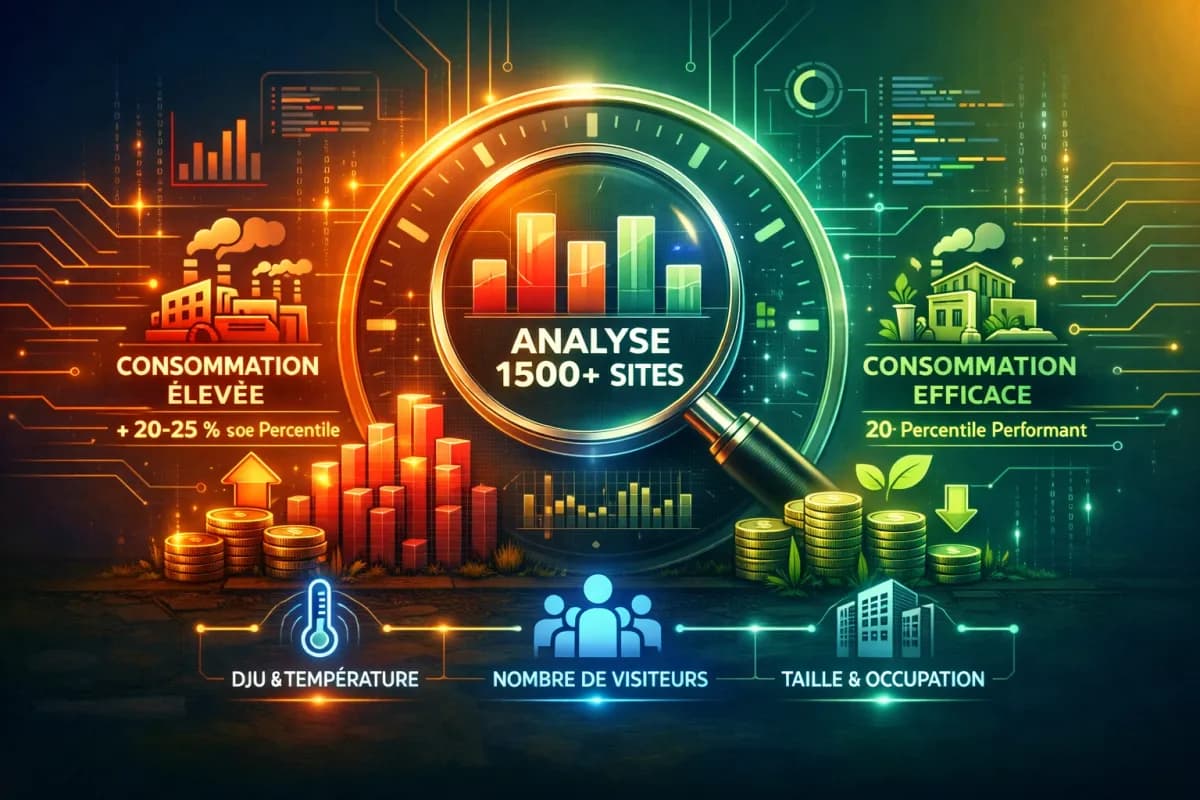
We set out to answer that question by analyzing over 1,500 sites across three major sectors. The finding was consistent: the average site consumes 20 to 25% more than the top-performing 20% of sites, regardless of sector. A significant share of your energy spend isn't structural. It's optimizable.
Key Takeaways
- Average buildings consume 20-25% more energy than top performers in the same sector
- Benchmarked buildings reduce energy use by 2.4% per year (EPA ENERGY STAR, 2025)
- 10-30% savings are achievable without major capital investment
- Normalization (climate, occupancy, activity) is essential for fair comparison
- Digital optimization can unlock up to 40% savings without equipment replacement
How Large Are the Energy Gaps Across Building Portfolios?
Buildings that benchmark their energy regularly reduce consumption by an average of 2.4% per year, according to
EPA ENERGY STAR data covering 35,000 properties. Our own analysis of 1,530 sites confirms this pattern and reveals how deep the gaps actually run.
We benchmarked each site using a straightforward indicator: annual energy consumption per square meter (kWh/m2/year). Here's what we found.
| Sector | Sites | Average (kWh/m2/year) | Top 20% (kWh/m2/year) | Gap |
|---|
| Retail and Commerce | 620 | 410 | 325 | +26% |
| Logistics and Warehousing | 480 | 185 | 150 | +23% |
| Offices and Commercial | 430 | 210 | 170 | +24% |
| Total | 1,530 | | | 20-25% |
Source: AICE Power analysis of 1,530 client sites, 2025.
These figures align with broader industry data. French offices average 126 kWh/m2/year according to the
OID Barometre (2025), while typical tertiary buildings consume around 240 kWh/m2/year in primary energy (
ADEME/Covalba). The range is vast: offices sit between 150-300 kWh/m2/year, retail between 200-400, and healthcare between 300-700 (
ADEME).
The same pattern repeats across every sector we've studied. Top-performing sites consume significantly less with no compromise on operations.
Why Do These Consumption Gaps Exist?
Across the EU, 97% of buildings need energy upgrades, and fewer than 3% hold an A-class energy performance certificate (
BPIE, 2024). The consumption gaps we observe aren't caused by one single factor. They're the result of compounding inefficiencies that accumulate over time.
Contrary to popular belief, building age and equipment vintage don't explain most of the variation. In our experience across client portfolios, we've found five recurring causes:
HVAC settings that drift over time. Heating and cooling setpoints get adjusted for one-off events and never reset. Across dozens of sites, these small changes compound into significant waste.
Operating schedules misaligned with actual occupancy. A building running its systems for 14 hours when it's only occupied for 10 wastes roughly 30% of its HVAC energy. We've seen this pattern repeatedly.
Gradual performance drift that goes undetected. Think of the boiling frog effect. A 1% monthly increase in consumption barely registers on a quarterly bill, but it adds up to 12% over a year.
Inconsistent operational practices across sites. When each facility manager operates independently, best practices don't spread. One site might run efficiently while a near-identical neighbor wastes energy.
No data-driven management culture. Without comparable indicators, these gaps remain invisible. You can't fix what you can't measure.
Is it surprising that so many buildings underperform? Not when you consider that the EU renovation rate stands at just 1% per year, far below the 3% needed to meet climate targets (
EPBD, 2024).
Why Do Raw Site Comparisons Mislead?
Electricity alone can represent up to 25% of a building's operating costs (
JLL, 2025), making accurate comparison essential for prioritizing investment. Yet comparing two sites solely on their energy bill or raw kWh/m2 is often dangerously misleading.
Not all sites face the same constraints. Several variables can skew any simple comparison:
- Climate: A building in Lille and one in Marseille face entirely different heating and cooling demands. Without degree-day corrections, their numbers aren't comparable.
- Activity intensity: A retail store with 5,000 daily visitors consumes differently from one with 500. Volume matters.
- Usable vs. total floor area: A warehouse with 30% mezzanine space and one without can't be compared on gross m2 alone.
- Occupancy patterns: A 24/7 logistics hub and a 9-to-5 office building exist in different energy universes.
- Sector-specific requirements: Refrigeration in food retail, server rooms in offices, and sterilization in healthcare each impose unique base loads.
Without normalization, you risk mispriorizing your investments entirely. We've seen portfolio managers pour capital into buildings that looked wasteful but were actually performing well given their constraints, while genuinely inefficient sites flew under the radar.
How Does Normalization Reveal True Savings Potential?
The
IEA (2025) reports that digital optimization can deliver up to 40% energy savings without replacing existing equipment. But capturing that potential starts with seeing the real picture, and that requires advanced normalization.
We apply several correction layers to make site comparisons fair and actionable:
Climate Corrections
Degree-day adjustments (DJU in France, HDD/CDD internationally) neutralize weather's impact on heating and cooling loads. A mild winter in Bordeaux and a harsh one in Strasbourg no longer distort the picture.
Activity-Based Indicators
Raw kWh/m2 doesn't tell the full story. We calculate usage-specific metrics: kWh per visitor for retail, kWh per pallet handled for logistics, kWh per workstation for offices. These reveal whether a building is truly inefficient or simply busier than its peers.
Occupancy and Size Adjustments
We factor in actually utilized floor area and hourly occupancy rates. A half-empty building and a fully occupied one need different baselines.
After these corrections, something important happens. The consumption gaps persist and actually become more credible. Over-consuming sites are clearly identified, and the savings potential becomes quantifiable on a site-by-site basis. In the majority of cases, we've found that 10 to 30% savings are achievable without heavy capital expenditure, through tuning, active management, and harmonization of operational practices alone.
How often do energy managers skip normalization and act on misleading data? In our experience, more often than they'd like to admit.
Why Is a Data Science Approach Essential for Portfolio Analysis?
ENERGY STAR certified buildings use 35% less energy and generate 35% fewer greenhouse gas emissions than comparable properties, saving an average of $0.54 per square foot in operating costs (
EPA, 2025). Achieving results like these across an entire portfolio demands more than spreadsheets.
At portfolio scale, the challenges multiply quickly:
- Heterogeneous data sources. Invoices, IoT sensors, building management systems, and utility feeds all speak different languages.
- Incomplete time series. Gaps in data are the norm, not the exception. Models need to handle missing months gracefully.
- Subtle anomaly detection. A 5% drift over six months won't trigger a simple threshold alert, but a statistical model catches it.
- Multi-site comparison at scale. Comparing 50 sites is manageable manually. Comparing 1,500 is not.
A recent meta-analysis found that hybrid AI methods can achieve 28.1% energy savings in buildings, while reinforcement learning alone delivers 22.3% and supervised learning 14.7% (
Springer Nature, 2025). The energy management systems market reflects this potential, projected to grow from $60.6 billion in 2025 to $158.6 billion by 2033 at a 12.7% CAGR (
Grand View Research).
The approach we've found most effective combines granular data collection via sensors and sub-metering, centralization in an EMS platform, statistical normalization models, dynamic benchmarks that evolve as sites improve, and continuous drift monitoring that catches regressions early.
It's this combination of software, data, and science that transforms an observation into an action plan.
What Benefits Extend Beyond Energy Savings?
In France, the Decret Tertiaire has already driven a 22% reduction in tertiary building energy consumption by 2022, reaching halfway to the 2030 target (
ADEME/OPERAT). Portfolio energy analysis supports compliance with this and other regulations, but the benefits reach further.
Operational Advantages
Data-driven prioritization replaces guesswork. When you can see exactly which sites underperform and why, you allocate your facility management team's time where it matters. Decisions rest on facts, not intuition. This is especially valuable for organizations managing hundreds of sites where attention is a scarce resource.
Financial Impact
Sustainable OPEX reduction compounds over time. A 2.4% annual improvement across 1,500 sites generates significant cumulative savings. Better data also means smarter CAPEX allocation: you invest in upgrades where the return is highest rather than spreading budget evenly.
ESG and Regulatory Compliance
With 98% of companies mapping ESRS E1 Climate Change as a material topic (
EFRAG/Normative, 2025), credible energy data is no longer optional. The
CSRD framework (2025) has narrowed its scope to companies with over 1,000 employees and EUR 450 million turnover, but those within scope need reliable, auditable energy intensity metrics and CO2 reduction evidence.
Portfolio analysis provides measurable improvement in energy intensity, verified emissions reductions, and the reliable indicators that non-financial reporting demands.
From Consumption Gaps to Lasting Performance
Consumption disparity isn't a marginal anomaly. It's a systemic opportunity. When the average site consumes 20-25% more than the best performers, the question shifts from "can we save?" to "how much and how fast?"
The answer depends on three pillars: reliable data collected at the right granularity, intelligent normalization that accounts for each site's real constraints, and a data science approach scaled across the entire portfolio. With over 330,000 buildings now benchmarked through EPA's Portfolio Manager alone, covering 25% of US commercial floor space (
EPA, 2025), the evidence is clear. Benchmarking works.
In France, where the tertiary sector covers 1.2 billion m2 and consumes 265 TWh, representing 17% of the country's final energy (
ADEME, 2024), the stakes couldn't be higher. Every percentage point of improvement matters at that scale.
Frequently Asked Questions
What is portfolio energy benchmarking?
Portfolio energy benchmarking compares the energy performance of multiple buildings using normalized indicators like kWh/m2/year. After adjusting for climate, occupancy, and activity, you can identify which sites underperform relative to their peers. EPA data shows that buildings engaged in benchmarking reduce energy consumption by 2.4% per year on average (
EPA ENERGY STAR, 2025).
How much can portfolio analysis save on energy costs?
Most portfolios contain 10-30% savings potential that's achievable without major capital investment. Our analysis of 1,530 sites shows a consistent 20-25% gap between average and top-performing buildings. Digital optimization alone can deliver up to 40% savings according to the
IEA (2025), primarily through operational adjustments.
Why is normalization important for building comparison?
Raw energy data is misleading because buildings operate under different conditions. Climate, occupancy hours, building activity, and sector-specific loads all affect consumption. Without degree-day corrections and activity-based metrics, you risk investing in the wrong sites. Normalization turns unfair comparisons into actionable insights.
Does portfolio analysis help with Decret Tertiaire compliance?
Yes. The Decret Tertiaire requires progressive reductions in tertiary building energy consumption, with a 40% target by 2030. France's tertiary sector had already achieved 22% reductions by 2022 (
ADEME/OPERAT). Portfolio analysis provides the normalized baselines, site-level tracking, and reporting data that compliance demands.
What data sources are needed for portfolio energy analysis?
Effective analysis requires energy invoices, sub-metering data from sensors and IoT devices, building management system (BMS) feeds, and contextual data like floor area, occupancy schedules, and climate zone. The more granular the data, the more precise the savings identification. An EMS platform centralizes these heterogeneous sources into a single analytical framework.