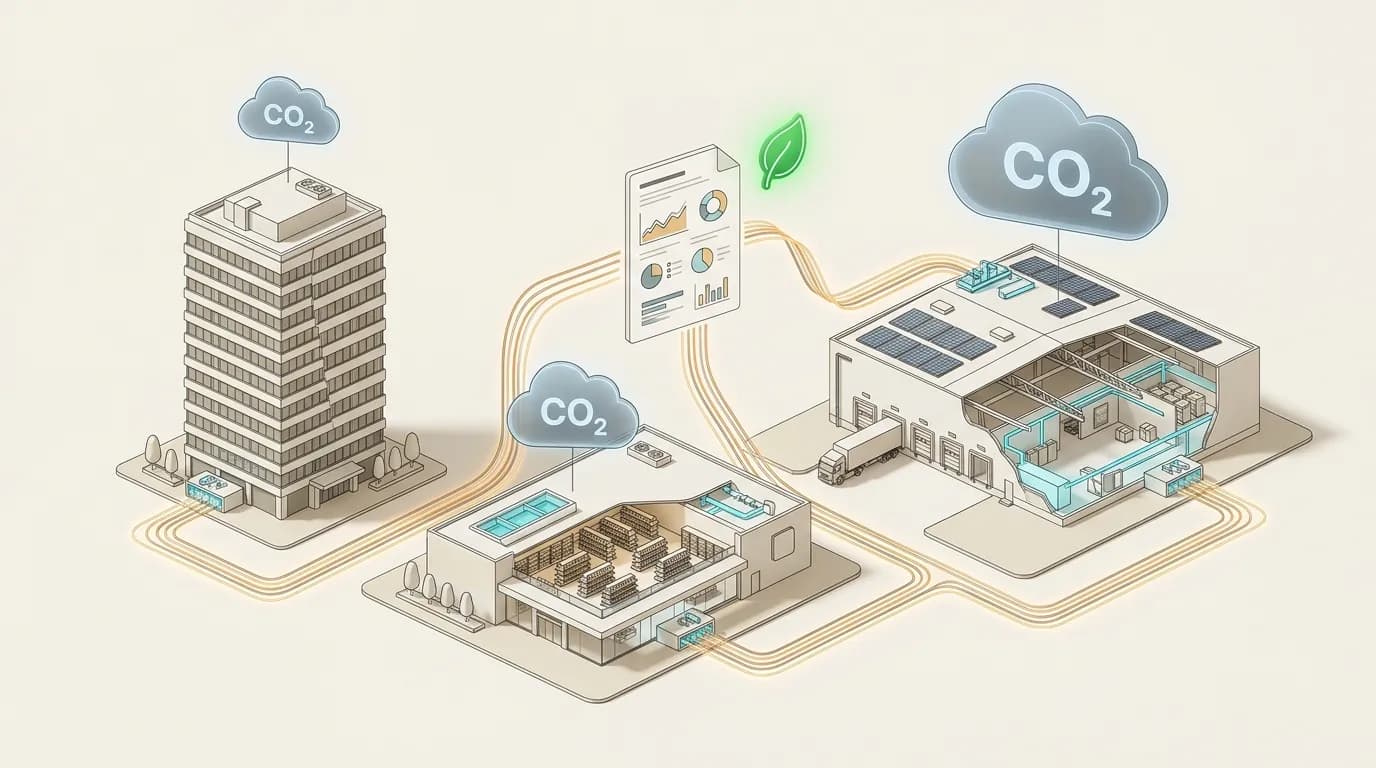
CSRD Scope 2 Reporting: Getting Your Building Energy Data Right
It's a Thursday afternoon. Your sustainability officer is staring at a spreadsheet with 47 tabs, one for each site. Half the energy data comes from utility invoices that arrived three months late. The other half was typed in manually by facility managers who rounded everything to the nearest hundred. The auditor wants Scope 2 numbers in two formats. Your CFO wants to know why this is costing more than last year's entire sustainability budget.
This scenario is playing out across Europe right now. The CSRD has moved energy reporting from a "nice-to-have" into a legally mandated obligation. And for companies with building portfolios, Scope 2 emissions are where theory meets messy operational reality.
The gap between "report your emissions" and "actually collect reliable per-site energy data" is enormous. This guide walks you through exactly what CSRD requires for building energy reporting, and how to get your data infrastructure right before auditors come knocking.
Key Takeaways
- ESRS E1 requires Scope 2 emissions using both location-based and market-based methods (EFRAG, 2024)
- 98% of reporting companies consider ESRS E1 (climate change) material (EFRAG, 2025)
- Buildings account for 40% of EU energy consumption and 36% of CO2 emissions (European Commission)
- 83% of professionals say accurate data collection is a challenge for CSRD compliance (PwC, 2024)
- The Omnibus directive reduced in-scope companies by roughly 80%, but energy-intensive sectors remain covered
- Automated monitoring cuts Scope 2 data collection from weeks to hours
What Does CSRD Actually Require for Building Energy Reporting?
What ESRS E1 demands
The standard requires three categories of disclosure:
- Greenhouse gas emissions broken down by Scope 1, 2, and 3, following the GHG Protocol framework
- Total energy consumption in absolute terms, plus improvement in energy efficiency
- Transition planning with targets tied to a 1.5C pathway and capital allocation
Companies must report gross emissions separately from any carbon credits or removals. No netting allowed. You can't offset your way out of transparent reporting.
For building operators, the most operationally demanding requirement is Scope 2. It's where purchased electricity, heating, and cooling get converted into emission figures. And the standard requires you to do it twice, using two different methods.
Does your current data infrastructure support that?
What Is the Difference Between Location-Based and Market-Based Scope 2?
Location-based method
This approach uses the average emission intensity of the electricity grid where your building operates. If your site is in Poland, where the grid relies heavily on coal, your emission factor is high. In France, with its nuclear-dominated grid, it's far lower.
For multi-site portfolios across Europe, this means the same kWh consumed produces radically different Scope 2 numbers depending on geography.
Market-based method
This method reflects the specific electricity you purchase. If you've signed a renewable energy power purchase agreement or hold Energy Attribute Certificates, your market-based Scope 2 can drop to zero for that portion of consumption.
The practical implication? A company could show 10,000 tonnes of CO2e under the location-based method and 2,000 tonnes under the market-based method for the same energy consumption. Auditors expect to see both figures, clearly separated.
Our finding: Across our client portfolio, we've observed that companies reporting both methods for the first time typically discover a 40-70% difference between their location-based and market-based Scope 2 figures. Those who haven't tracked energy procurement contracts at the site level can't produce the market-based figure at all.
Who Reports When? The CSRD Timeline After Omnibus

Here's the current landscape:
But here's what the headlines miss. If you operate energy-intensive buildings or you're part of a large enterprise's value chain, your data obligations haven't gone away. Wave 1 companies are already asking suppliers for Scope 3 data. And that Scope 3 request flows downhill as a Scope 2 data requirement for building operators.
Are you prepared to deliver that data on demand?
What Data Do You Actually Need for Scope 2 Compliance?
Getting Scope 2 right requires granular operational data that most companies simply don't have. The typical sustainability report draws from annual utility bills. ESRS E1 demands something far more precise.
The data requirements
For each reporting entity, you need:
- Total energy consumption in kWh, broken down by electricity, heating, cooling, and steam
- Consumption per site, not just a corporate aggregate
- Source of energy, distinguishing grid electricity from on-site generation and renewable contracts
- Emission factors specific to each country grid (location-based) and each energy contract (market-based)
- Time-series data demonstrating year-over-year trends and progress toward targets
- System-level breakdown where material, separating HVAC, lighting, refrigeration, and process loads
A company operating 50 retail sites across four countries needs 50 site-level consumption datasets, applied against at least four different grid emission factors, plus documentation of any renewable energy contracts per site. Multiplied by two methods.
That's not something you assemble from quarterly invoices.
The emission factor challenge
Using outdated factors means your Scope 2 figures are wrong before the auditor even opens the file. And with emission intensity varying by up to 90x between countries like Poland and Sweden, applying the wrong factor isn't a rounding error. It's a material misstatement.
Why Is Multi-Site Data Aggregation So Difficult?
Common failure points
What happens when the data that's supposed to go into your CSRD report is scattered across 47 different systems?
Our finding: Companies transitioning from manual to automated energy data collection typically reduce their Scope 2 data preparation time from 6-8 weeks to under 48 hours. The error rate in emission calculations drops from 15-25% (manual data entry) to under 2% (automated metering with validated emission factors).

How Does Energy Monitoring Automate Scope 2 Data Collection?
Automated energy monitoring solves the data collection problem at its root. Instead of chasing invoices and reconciling spreadsheets, IoT sensors capture consumption data continuously and feed it into a centralized platform.
What a monitoring system captures
A properly deployed energy monitoring platform collects:
- Real-time electricity consumption at 10 to 15-minute intervals per circuit
- Sub-metered system loads separating HVAC, refrigeration, lighting, and other systems
- Power quality metrics including power factor, demand peaks, and reactive energy
- Temperature and environmental data for normalization and anomaly detection
- Automated aggregation across all sites into a single dashboard
This transforms Scope 2 reporting from a compliance burden into a byproduct of normal operations. The data exists. It's validated. It's timestamped. And it's audit-ready.
From raw data to emission figures
The calculation itself is straightforward once you have clean data:
The complexity isn't in the formula. It's in getting accurate inputs at scale. Monitoring handles the consumption side. Emission factor databases handle the conversion side. Automation connects the two.
How Does CSRD Connect to the Decret Tertiaire and EPC Ratings?
For companies operating buildings in France, CSRD doesn't exist in isolation. It intersects with two other regulatory frameworks that demand the same underlying data.
Decret Tertiaire
The overlap is significant. Both CSRD and the Decret Tertiaire require per-site energy consumption data in kWh. Both require year-over-year trending. Both demand documented reduction targets. A company already tracking energy for the Decret Tertiaire has 80% of the data it needs for CSRD Scope 2 reporting.
Non-compliance with the Decret Tertiaire can also create indirect problems for CSRD reporting, including difficulties with ESG initiatives and potential loss of real estate asset value.
Energy Performance Certificates
EPC ratings feed directly into CSRD reporting. A building's energy class signals its operational efficiency and transition risk. Investors and auditors increasingly expect to see EPC data alongside Scope 2 figures.
How Do You Turn Compliance Into Competitive Advantage?
Here's the uncomfortable truth about CSRD. Many companies are treating it as a box-ticking exercise. Spend the minimum. Hire a consultant. Produce a report. Move on. That's a missed opportunity.
Companies that build genuine energy data infrastructure don't just comply. They operate better.
The operational upside
When you instrument your buildings for Scope 2 reporting, you simultaneously gain:
-
Fault detection that catches equipment problems within hours instead of months. Our clients consistently see this translate into measurable savings in the first 90 days.
-
Benchmarking across your portfolio that identifies the worst performers and quantifies the savings gap. Our analysis of 1,500+ sites shows average buildings waste 20-25% more than top performers.
-
Cost reduction from operational fixes that require zero capital expenditure. Schedule corrections, setpoint adjustments, and fault repairs routinely recover 8-15% of energy spend.
-
Bill validation that catches the overcharges and tariff mismatches hidden inside commercial electricity bills.
-
Procurement intelligence that informs better energy contracts, directly improving your market-based Scope 2 figure.
The regulatory pressure is real. But the companies that treat energy data as a strategic asset, not a compliance cost, will come out ahead.
Our finding: Among our clients who deployed energy monitoring primarily for CSRD compliance, 100% identified operational savings opportunities within the first quarter. The average net benefit, after deducting monitoring costs, exceeded the compliance cost by a factor of 3 to 5x. Compliance paid for itself before the first report was submitted.
What Should You Do Right Now?
Whether you're in Wave 1 and already reporting, or in the delayed Wave 2 preparing for 2028, the actions are the same. The only difference is urgency.
For Wave 1 companies (reporting now)
You've submitted your first report. The question is whether your data will survive reasonable assurance. Auditors in the next cycle will scrutinize methodology and data sources more closely. Now is the time to shift from manual data assembly to automated collection.
For Wave 2 companies (reporting from 2028)
The Omnibus gave you a two-year extension. Don't waste it. Use 2026 and 2027 as preparation years to scope your data needs, deploy monitoring, and run shadow reports. Companies that wait until 2027 to start will repeat the same panicked scramble that Wave 1 experienced.
For value chain participants
Even if you're below the CSRD threshold, large clients will request your energy data. The VSME voluntary standard provides a framework, but having actual metered data rather than estimates puts you in a stronger position. Companies that fall below the 1,000-employee threshold can refuse requests beyond the VSME standard, but cooperation builds commercial relationships.
Five immediate steps
- Audit your current data. Can you produce per-site kWh figures for last year within a week? If not, you have a data gap.
- Map your energy contracts. Which sites have renewable energy agreements? Which use the default grid mix? This determines your market-based figures.
- Identify your emission factors. Use the IEA or EEA country-level factors for location-based. Collect supplier-specific factors for market-based.
- Deploy monitoring where gaps exist. Non-invasive IoT sensors can be installed in hours without disruption. Learn how with supermarket energy monitoring as a starting example.
- Run a shadow calculation. Produce both location-based and market-based Scope 2 figures for your full portfolio before the deadline. Fix data quality issues now, not during the audit.
Frequently Asked Questions
What is Scope 2 under CSRD, and how is it different from Scope 1?
Scope 1 covers direct emissions from sources your company owns or controls, such as gas boilers or company vehicles. Scope 2 covers indirect emissions from purchased electricity, heating, cooling, and steam. For commercial building operators, Scope 2 is typically the larger category because electricity consumption dominates energy use. ESRS E1 requires both to be reported separately, with no netting against carbon credits.
Do I need to report Scope 2 using both location-based and market-based methods?
Yes. ESRS E1 follows the GHG Protocol and requires dual reporting. The location-based method uses average grid emission factors for each country. The market-based method uses factors from your specific energy contracts, renewable certificates, or supplier disclosures. Both figures must appear in your report. This dual requirement is what makes per-site energy contract documentation essential.
Has the Omnibus directive eliminated CSRD requirements for my company?
Not necessarily. The Omnibus reduced the number of directly in-scope companies by roughly 80%, primarily by exempting most SMEs and delaying Wave 2 by two years. However, if you operate within the value chain of a large enterprise, you may still receive data requests. And companies in energy-intensive sectors like retail, logistics, and hospitality remain covered if they meet the revised thresholds. Check the updated criteria against your employee count and revenue before assuming you're exempt.
How does the Decret Tertiaire relate to CSRD Scope 2 reporting?
Both regulations require per-site energy consumption data in kWh with year-over-year tracking. The Decret Tertiaire mandates 40% energy reduction by 2030 for French tertiary buildings over 1,000 m2. CSRD adds the requirement to convert that consumption into emission figures using standardized factors. Companies that are already compliant with the Decret Tertiaire have the majority of data needed for CSRD Scope 2. The same monitoring infrastructure serves both frameworks.