Demand Response: How Supermarkets Get Paid by the Grid
Remi BouteillerApr 28, 2026
While the registers ring and the freezers hum, another revenue stream flows through the supermarket. Invisible. It comes from the grid. France's transmission system operator, RTE, pays selected stores to occasionally throttle their consumption when the supply-demand balance gets tight.
This is not a future program. It is a market that already runs. In 2025, the grid operator contracted 2,372 MW of demand response capacity with industrial and tertiary players, at prices guaranteed for one year. And that is only one of four available revenue streams.
Carrefour France now pilots 68 hypermarkets on real-time electrical flexibility. Casino installs second-life batteries on its parking lots. French grocery retail has understood that its kilowatts are not just a cost. They have a resale value.
Key Takeaways
The latest decarbonised flexibility tender (AOFD 2025) from RTE selected 2,372 MW at EUR 28,863/MW, with a bonus of up to EUR 10,000/MW for low-carbon assets (Enerdigit / RTE, 2024)
The PPE 3 multi-year energy plan sets a target of 6.5 GW of demand response by 2030, more than double the current capacity (PPE 3 draft, 2025)
Carrefour France pilots 68 hypermarkets via Tilt Energy, with several dozen MW of flexible capacity activated in real time across refrigeration, heating and lighting (La Revue du Digital, 2025)
The French demand response sector reaches 94% activation reliability, higher than most conventional generation assets (Voltalis / Energy Pool / Flexcity, 2022)
What Is Demand Response, and How Does It Pay?
Demand response is the practice of voluntarily reducing electricity consumption on request from the grid operator, in exchange for compensation. RTE contracted 2,922 MW under its 2024 demand response tender at the cap price of EUR 65,000/MW (Enerdigit, 2024). In plain words: RTE pays you to not consume for a few hours, a few times a year.
The economic logic is straightforward. When demand outpaces supply, the grid has two options. Start a peaking thermal plant, or pay consumers to step back. The second route is often cheaper, faster, and emits less CO₂. A Connaissance des Énergies analysis notes that demand response can be activated within minutes, while a gas plant takes half an hour to ramp (Connaissance des Énergies, 2024).
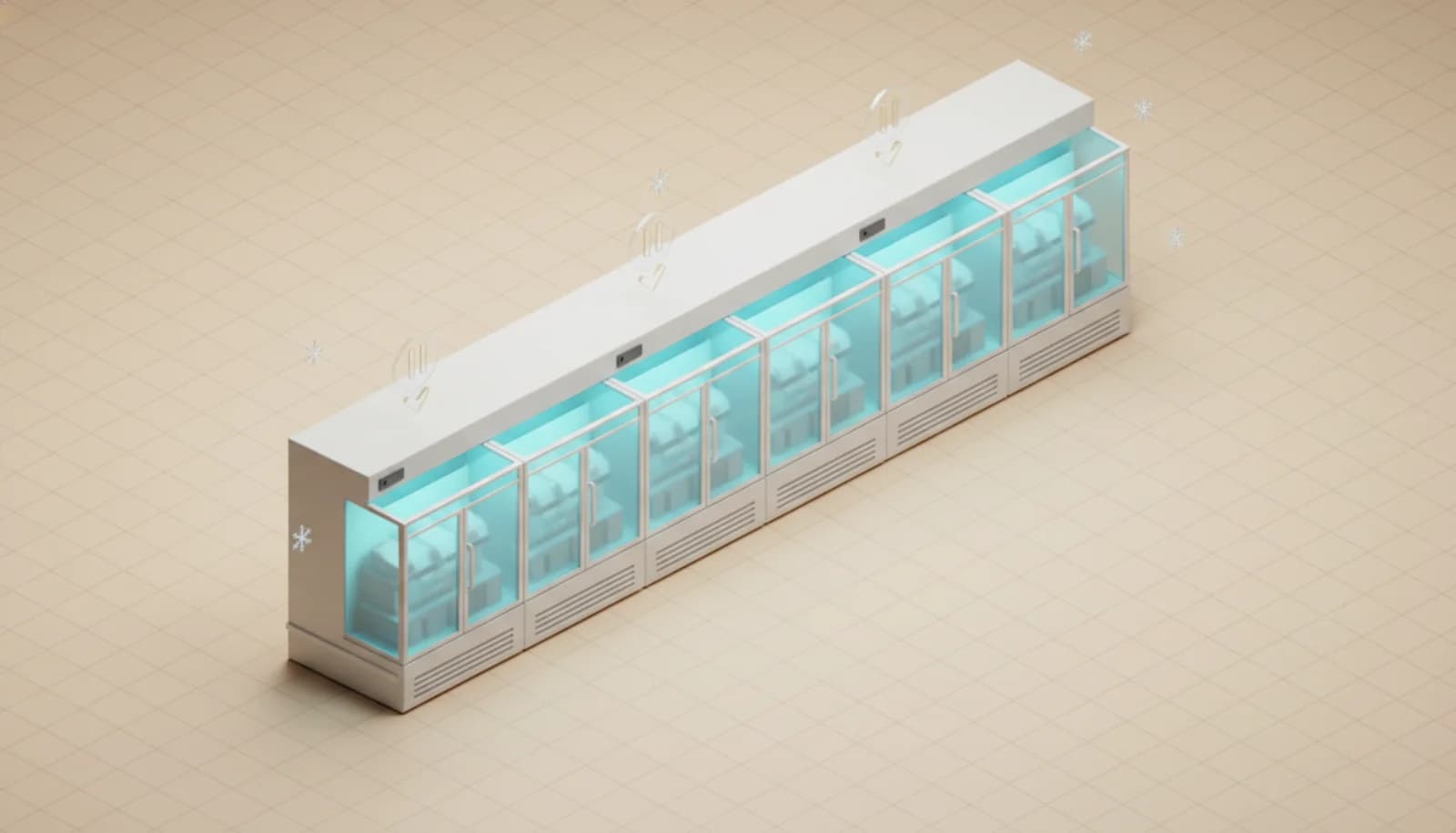
For a supermarket, "not consuming" does not mean closing the store. It means temporarily switching off the refrigeration compressors, lowering heating by two degrees, dimming aisle lighting. Customers do not notice. The register keeps ringing. But the meter reads 200 to 500 kW less for 15 to 60 minutes.
Our take: Demand response is not an energy product in the classic sense. It is an insurance product. You do not sell kilowatt-hours, you sell the promise of being available. Most of the revenue lands without any actual curtailment happening. That is exactly what makes the model so attractive to grocery retail: near-zero operating cost for recurring revenue.
Four French markets let a supermarket or chain monetise this flexibility. The classic demand response tender (AOE), the new decarbonised flexibility tender (AOFD) replacing it, the capacity mechanism, and the NEBEF mechanism, which sells curtailed energy on the wholesale market. Aggregators (Voltalis, Flexcity, Energy Pool, Smart Grid Energy) stack these revenues to maximise return per site.
The latest decarbonised flexibility tender (AOFD 2025) from RTE selected 2,372 MW at an average price of EUR 28,863.64/MW, with a bonus of up to EUR 10,000/MW for low-carbon assets (Enerdigit, 2024). For a hypermarket contracting 500 kW, that means EUR 14,400 to EUR 19,400 per year, guaranteed, just for being available.
The transition from AOE to AOFD has been controversial. RTE initially planned 4,900 MW for delivery year 2025. The DGEC trimmed the volume to 2,400 MW, a decision the sector criticised as "contradictory with PPE objectives" (Actu-Environnement, 2024). Prices logically dropped: without scarcity, no upward tension on auctions.
For delivery year 2026, RTE has already selected 2,803 MW in the main AOFD session, a sign that the tool stays central despite the volume cut (Enerdigit, 2024). And the long-term trajectory remains ambitious. PPE 3 targets 6.5 GW by 2030 (PPE 3 draft, 2025).
For a retail operator, the practical reading is this. A site that can reliably curtail 200 to 500 kW generates EUR 5,800 to EUR 19,400 in annual revenue at AOFD 2025 prices. Multiplied by 100 stores, that becomes EUR 580,000 to EUR 1.9M per year, with no major capex. For an aggregator running the fleet, that easily funds the service and still leaves a substantial share for the operator.
Does the Capacity Mechanism Still Have Value in 2026?
The capacity mechanism, France's second flexibility pillar, is in the middle of a dramatic price slump. For delivery year 2025, the December 2024 auction cleared at EUR 0/MW, against an annual average of EUR 14,650/MW (Connaissance des Énergies, 2024). In December 2025, the auction for delivery 2026 closed at EUR 98.6/MW, 96% below the EUR 2,620/MW reached in October (Limpide, 2025).
Why the collapse? Three reasons. The recovery of the French nuclear fleet, which produced 361.7 TWh in 2024, the highest level since 2019. Mild weather that calmed winter demand. And the mass arrival of demand response and battery capacity on the market. When the grid feels comfortably oversized again, reserve assets lose their scarcity value.
This is about to change. From 1 November 2026, RTE becomes the single buyer of the new capacity mechanism, with a first auction scheduled for July 2026 (Hayaenergy / RTE, 2025). The reform aims to stabilise prices through long-term contracts, better suited to flexibility investments. Supermarkets that get qualified now can lock in those multi-year contracts the moment they open.
Our take: The 2025-2026 capacity trough is a trap for short-term thinking. Operators who exit the market today because prices are low will have to start over in 18 months when RTE rolls out long-term auctions. Better to consolidate eligibility and reliability history now and capture the multi-year contracts of the new design.
To gauge the gap between your current consumption and your demand response potential, start from your energy tracking baseline.
Which French Supermarkets Already Run Demand Response?
Carrefour France pilots 68 hypermarkets through Tilt Energy's AI platform since 2025, adjusting commercial refrigeration, heating and HVAC in real time to deliver several dozen MW of flexible capacity (La Revue du Digital, 2025). The retailer targets several hundred MW long-term. Tilt Energy won the Energy Flexibility Prize at the 2025 Perifem Awards for the solution (Tilt Energy, 2025).
Casino, through its subsidiary GreenYellow, took the experiment further by installing a second-life battery on the parking lot of its La Ricamarie pilot site. The battery delivers frequency regulation to RTE and participates in the capacity mechanism, while also managing on-site solar self-consumption (GreenYellow, 2023). The group also reduced electricity consumption per square metre of sales floor by 20% between 2012 and 2020.
The most visible collective precedent remains the inter-distributor protocol signed on 15 October 2022 by Leclerc, Carrefour, Système U, Intermarché, Auchan, Casino, Franprix, Monoprix, Lidl and Picard. During the energy crisis, these chains committed to cutting pre-opening lighting by 50%, dropping peak-hour loads (8am-12pm and 6-8pm) by 30%, and lowering store temperature to 17 °C on critical signals (Lidl France / Perifem, 2022). No EcoWatt orange or red signal has been issued since the scheme launched, but the chains kept the operational routines.
What we see in the field: Looking at 10-minute interval curves of the stores we monitor, late-afternoon refrigeration compressor curtailment leaves a very clean signature. A 30 to 40% step down on subscribed power, with no measurable impact on aisle temperatures. Operators often discover they were already doing de facto demand response through their BMS, without monetising it on the grid side.
The French demand response sector reaches 94% activation reliability according to the joint communication from Voltalis, Energy Pool and Flexcity, a level higher than most conventional generation assets (Voltalis, 2022). Supermarkets are heavily represented because they combine volume, predictability and controllability.
To analyse which stores in your portfolio offer the most monetisation potential, our portfolio analysis method compares sites against each other and surfaces the most flexible.
How Much Can a Supermarket Actually Earn?
A 5,000 m² hypermarket with 500 kW of flexible capacity can generate EUR 14,400 to EUR 19,400 per year in pure AOFD revenue at 2025 clearing prices, bonus included (Enerdigit, 2024). Stacking the capacity mechanism (variable by year), NEBEF revenues from real activation events, and any balancing premiums, the realistic total reaches EUR 20,000 to EUR 35,000 per site per year under normal market conditions.
Three variables drive the spread:
1. Reliability profile. RTE and aggregators pay for availability but penalise activation failures. A site that fails its qualification tests loses its contract. Sector-wide reliability sits at 94%, but the best operators exceed 98% thanks to smart controllers and active supervision.
2. Curtailable size. Below 100 kW, AOFD qualification constraints turn unfavourable. Above 500 kW, compensation becomes fully competitive. Chains pool sites through an aggregator to cross those thresholds.
3. Market mix. A store registered only for AOFD earns less than a site combining AOFD, capacity, NEBEF and ancillary services (secondary reserve). Sophisticated aggregators stack these revenue streams.
2024 illustrates why the mix matters. RTE counted 359 hours of negative spot prices (4% of the time, twice as many as 2023) and several spikes above EUR 500/MWh during cold snaps (RTE, 2025). Operators able to modulate consumption profit from both extremes. They consume when it is cheaper, sometimes paid, and curtail when it is expensive.
How Do You Sign Up? The Practical Path in Six Steps
Starting a demand response program is not an R&D project, it is an operational rollout. Here is the proven sequence French operators use.
Step 1: Characterise available flexibility. Install submetering on your refrigeration, HVAC and lighting circuits. Measure the average power and its profile over 30 days. Most hypermarkets discover 300 to 700 kW of truly flexible capacity, against 1 to 3 MW of subscribed power.
Step 2: Pick an aggregator. Voltalis, Flexcity (Veolia), Energy Pool, Smart Grid Energy, Tilt Energy and GreenYellow cover the French market. They handle AOFD bidding, capacity auctions, NEBEF settlement and revenue sharing. The standard contract runs 3 to 5 years with a 70/30 or 80/20 split in the site's favour.
Step 3: Install smart controllers. Common refrigeration brands (Danfoss, Carel, Bitzer, Eliwell) accept control modules that receive instructions from the aggregator. Installation takes one to two days per store with no service interruption.
Step 4: Pass RTE qualification. Each site or pool must prove its curtailment capacity through real tests supervised by RTE. Qualification typically takes 30 to 60 days. Aggregators handle the procedure.
Step 5: Activate pre-cooling. Set your refrigerated cabinets to cool 1 to 2 °C below the standard setpoint in the hour before typical curtailment windows (4-8pm in winter). This tactic doubles the available curtailment duration without any food safety risk.
Step 6: Collect capacity and activation revenues. You receive a monthly availability fee, plus a premium per actual activation. Most of the revenue lands without any real curtailment, simply because you are ready.
For chains that want to delegate the entire sequence without disrupting store teams, our automated demand response offer for supermarkets handles RTE qualification, refrigeration, HVAC and lighting control, and per-site guaranteed revenue sharing.
The European demand response market represents an EUR 8 billion annual opportunity that C&I players are barely capturing, according to McKinsey (McKinsey, 2024). French grocery retail, with its 12,000 supermarkets and hypermarkets, accounts for a meaningful share that is still largely untapped.
For operators who want to size their potential without commitment, our load shifting strategies guide explains the internal savings you can capture alongside market revenues.
Frequently Asked Questions
What is the difference between demand response and the capacity mechanism?
Demand response is an activation promise. RTE can ask you to drop consumption for a few hours. The capacity mechanism is a broader winter availability promise, with no systematic activation. Both pay revenues, and a single site can stack them. Capacity dropped to EUR 98.6/MW for 2026 but is expected to rebound after the November 2026 RTE reform.
Do I have to close the store during a curtailment event?
No. A typical curtailment switches off refrigeration compressors, lowers the HVAC setpoint by 1-2 °C, or dims back-aisle lighting. Registers run, aisles stay open, food temperatures stay within regulatory thresholds. Customers notice nothing.
What initial investment is required?
For a store already equipped with a BMS and recent refrigeration controllers, the investment is limited to a control module and aggregator setup, around EUR 5,000 to EUR 15,000 per site. Older stores need a BMS upgrade, but most chains have already done that work as part of BACS 2026 compliance.
What is the risk for frozen products?
Regulation requires frozen goods to stay below -18 °C. French walk-in freezers run at -22 to -25 °C. A 30-minute outage raises temperatures by 0.5 to 1 °C, well below the threshold. Preventive pre-cooling further widens the margin.
How long until the first revenue arrives?
From signing with an aggregator to the first payment, plan for 4 to 6 months on average: 30-60 days of RTE qualification, controller integration, then the first billing cycle. Capacity and AOFD revenues then land monthly.
Your Kilowatts Have Market Value. Go Get It
The French grid needs 6.5 GW of demand response by 2030, more than double today. Long-term contracts under the new capacity mechanism open in July 2026. Retailers who qualify their stores now will lock in those multi-year deals before competitors catch up.
Carrefour pilots 68 hypermarkets. Casino installs batteries. The inter-distributor protocol aligned ten chains. French grocery retail is only waiting for one thing: individual operators to follow the move.
Your compressors, your HVAC plants and your lighting are already paid for. The question is whether you let RTE pay you on top to operate them smartly. See how AICE automates demand response for your supermarkets without any in-store action, or start by measuring your potential with our energy tracking guide.
We use cookies to improve your experience and analyze site usage. Privacy policy