Installing Battery Storage at a Supermarket: 2026 Guide
Remi BouteillerApr 29, 2026
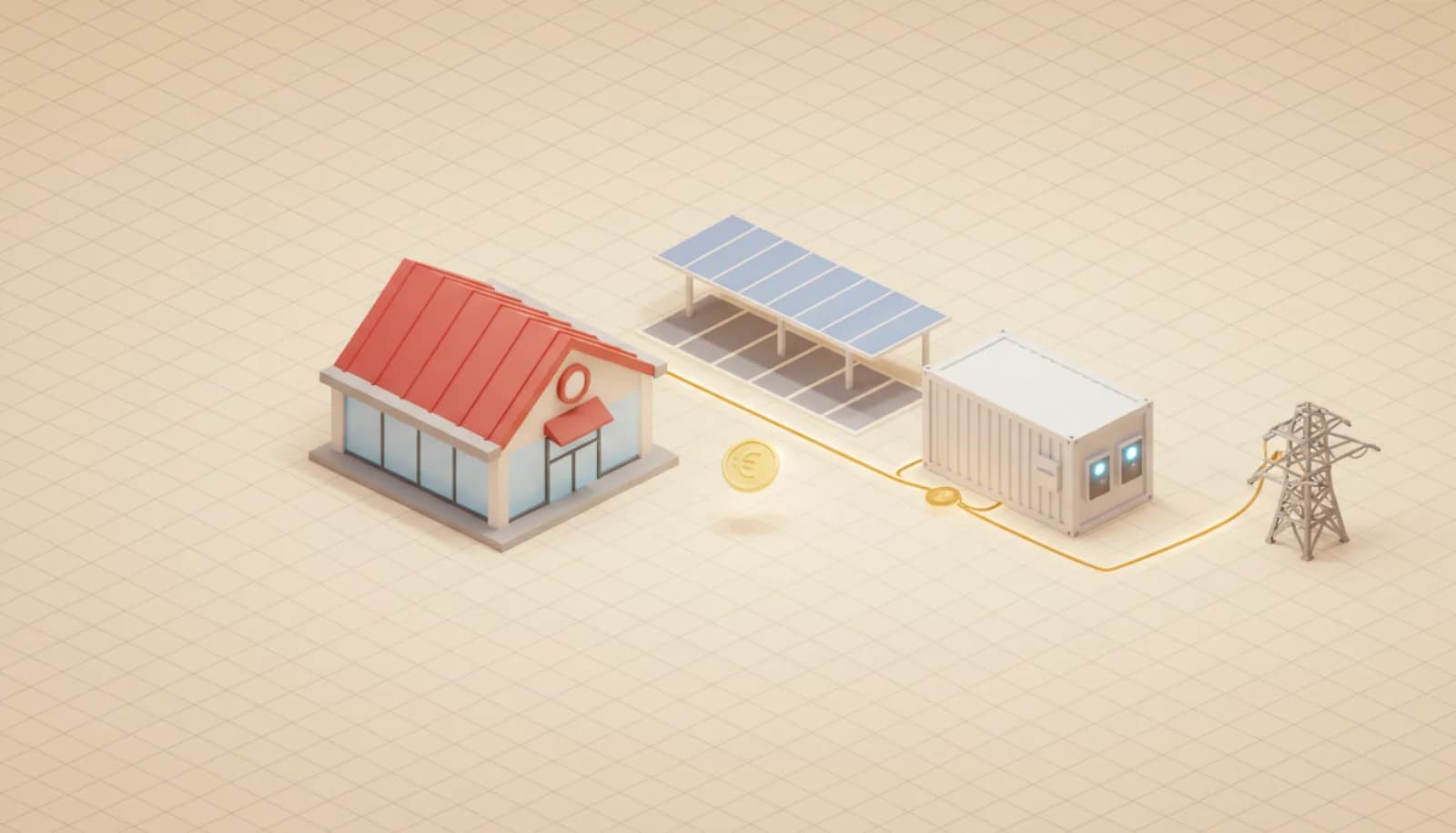
The Géant Casino supermarket in La Ricamarie has hosted a 270 kWh battery since November 2022, assembled from second-life modules pulled out of electric vehicles. It delivers primary frequency regulation to RTE, participates in the capacity market, and acts as on-site backup power. Casino paid zero capex.
What looked like a one-off pilot three years ago has gone mainstream. France's installed battery fleet jumped from a few megawatts in 2022 to 1.32 GW at the end of Q3 2025, with 1.46 GW expected by year-end and over 7 GW of grid-connection requests sitting in RTE's pipeline (Modo Energy, 2025). Over the same period, the price of a turnkey battery dropped 45% year-on-year to USD 117/kWh on average globally, USD 177/kWh in Europe (BloombergNEF / Energy-Storage.News, 2025).
For a supermarket operator, the combination is explosive. Procurement prices halved. Revenue markets opened. Third-party ownership models neutralised the capex barrier. And the commercial refrigeration that already runs on every store doubles as a pilotable load around the battery. The supermarket becomes a mini power plant.
Key Takeaways
Turnkey battery prices crashed to USD 117/kWh in 2025, down 45% year-on-year, opening 5- to 8-year paybacks on stacked use cases (BloombergNEF, 2025)
France had 1.32 GW of operational batteries at end Q3 2025 with over 7 GW of RTE grid-connection requests, doubled since 2022 (Modo Energy, 2025)
A battery on the secondary reserve market (aFRR) typically earns EUR 50,000-150,000/MW/year in Europe, plus EUR 19,000-30,000/MW/year on mFRR (Modo Energy, 2025)
Second-life batteries pulled from electric vehicles run roughly 30% cheaper than new ones, and Renault Mobilize already operates around 20 MWh of them in France (Mobilize, 2024)
Why Install a Battery at a Supermarket in 2026?
Three curves cross in 2026. Equipment prices are falling, revenue markets are widening, and grocery retail is hunting for concrete decarbonisation levers on its trading floors. The economic moment is the one early adopters like Casino started exploiting in 2022 and that more conservative chains can now embrace without taking pioneer risk.
First, the hardware. Lithium-iron-phosphate (LFP) chemistry has replaced NMC on virtually every new stationary deployment. It holds 6,000 to 10,000 cycles to 70-80% remaining capacity, which translates to 15-20 years of calendar life under one cycle per day (Energy-Storage.News, 2025). Round-trip efficiency reaches 90 to 96.5%, against 85% five years ago. The technology is mature.
Second, the market. France Renouvelables recommends a PPE 3 target of 6 GW of stationary batteries by 2030 and 10.5 GW by 2035 to balance the grid against variable renewables (France Renouvelables, 2025). The 7 GW of grid-connection requests already on RTE's books (RTE Cartostock, 2025) show that this trajectory is already executing, not debating.
Our take: The classic mistake is to think "battery" as an investment project. On a supermarket, it is a project to monetise an already-flexible load. Commercial refrigeration is doing thermal load shifting today, HVAC is responding to RTE signals today, and a battery simply adds another revenue layer with no operational change. Framed this way, the question is not "should we buy a battery" but "who collects the revenue". You, or your competitor?
Third, the competitive context. Lidl, Carrefour, Système U, Casino and Decathlon have all run battery storage pilots between 2022 and 2025. A retailer with no battery in 2026 sits 2-3 years behind on the operating learning curve, on relationships with aggregators, and on positioning for the long-term contracts of the reformed capacity mechanism that goes live November 2026.
To understand why commercial refrigeration is the natural ally of a battery, see our guide on refrigeration as a hidden battery which breaks down the thermal-inertia complementarity.
How Much Does a Supermarket Battery Cost?
A typical battery for a 5,000 m² hypermarket runs 250 kWh to 1 MWh, sized to shed 1-2 hours of evening peak consumption and capture 20-30% of the daily site flexibility. At BNEF's 2025 European turnkey price of USD 177/kWh (~EUR 165/kWh), a 500 kWh system clocks in around EUR 82,500 before grid connection, civil works and housing (BloombergNEF, 2025). With ancillary costs, a real C&I project lands between EUR 280 and EUR 450 per kWh installed all-in, or EUR 140,000 to EUR 225,000 for 500 kWh.
Second-life opens an alternative path. Renault Mobilize sells reconditioned batteries pulled from electric vehicles at roughly 30% below new equivalent, and already operates around 20 MWh installed in France (Mobilize, 2024). For a supermarket, second-life suits curtailment and peak-shaving use cases well, where cycling demands are moderate. For aFRR delivery, where dynamic response matters more, new units stay preferable.
The Enedis grid connection cost is the second big line item. For a 250-500 kVA battery wired to the supermarket low-voltage panel, the Enedis bill ranges from EUR 3,200 to EUR 30,000 depending on the existing connection state and required network works (Selectra, 2026). Lead times run 5 to 10 months for an HTA delivery, less for LV.
To benchmark these numbers against your current consumption, hourly energy tracking is the indispensable preamble.
How Do You Finance a Battery Without Capex?
The model that now dominates grocery retail is Third-Party Ownership (TPO). A third-party investor (GreenYellow, Tikehau Energy Transition, Mirova, Engie B2B) finances, owns and operates the battery on your site, under a 10- to 15-year long-term contract. You provide the location, the investor provides the capital and captures the market revenues, shared per a contractual formula.
The GreenYellow pilot at Géant Casino La Ricamarie illustrates exactly that pattern. Casino paid no capex. The battery sits behind the meter, contracted for 15 years, stacking RTE primary frequency regulation, the capacity mechanism and on-site backup (GreenYellow, 2022). On top, Casino enjoys a peak-hour bill reduction, with no euro committed.
The Power Storage Agreement (PSA), a TPO variant, instead fixes a guaranteed price per MWh of service rendered: peak shaving, demand response, or aFRR availability. It is the storage equivalent of a solar PPA. It suits chains that want to forecast their energy line precisely over 10 years.
Financial leasing offers a third, more traditional option. The battery sits on the balance sheet as a leased asset, you collect all revenues and pay a monthly lease fee. Pro: full margin capture. Con: balance sheet impact and exposure to revenue downside if capacity or aFRR markets weaken (the 2026 capacity cleared at EUR 98.6/MW, 96% below October 2025 (Acciona, 2025)).
Our take: The financing choice depends less on cost of capital than on internal capacity to operate a battery on the markets. A retailer without a specialist energy desk should default to TPO or PSA: the investor takes the market risk and brings the expertise. A chain with a team able to arbitrage aFRR/mFRR/intraday can capture more value as owner-operator, provided it accepts the volatility.
How Much Does a Supermarket Battery Earn?
Revenue is built by stacking, never from a single use. A battery monetises three to five flows simultaneously: RTE ancillary services (aFRR, mFRR), capacity mechanism, intraday spot arbitrage, peak shaving (savings on the store's own bill), and demand response payments.
aFRR (secondary frequency reserve) is the dominant flow. Since November 2023, this service moved from a regulated framework to an open auction, and France joined the European PICASSO platform in April 2025 (ESS-News, 2026). Typical European earnings sit between EUR 50,000 and EUR 150,000/MW/year for an aFRR-qualified battery, plus EUR 19,000 to EUR 30,000/MW/year on mFRR (Modo Energy, 2025).
Peak shaving on the supermarket's own bill adds EUR 20,000-40,000/MW/year. For a hypermarket paying EUR 0.15-0.18/kWh in peak hours, shaving 200-500 kW for 100 hours per year delivers EUR 5,000-15,000 in immediate savings, with no market participation required.
What we see in the field: On the batteries we monitor, aFRR revenues account for 60-70% of the stacked total, peak shaving 15-20%, and capacity + arbitrage the rest. The hierarchy shifts dramatically when the capacity mechanism returns to healthy prices (above EUR 5,000/MW). In 2026, the winning play is to maximise aFRR while preparing for the long-term contracts of the reformed capacity mechanism due in July 2026.
To pair these market revenues with refrigeration-side demand response, read our supermarket demand response guide. Both schemes operate on the same delivery point.
ICPE 2925-2: The Regulatory Compliance
Every stationary electrochemical storage battery now falls under ICPE rubric 2925-2, created by decree in October 2023 to cover lithium-ion (and other non-hydrogen) chemistries (AIDA INERIS, 2024). The main threshold is cumulative site charge power: above 50 kW, the declaration regime applies (filed with the prefecture), with a ministerial order prescribing fire safety. Above higher thresholds (authorisation), an in-depth review is required by the regional environment agency (DREAL).
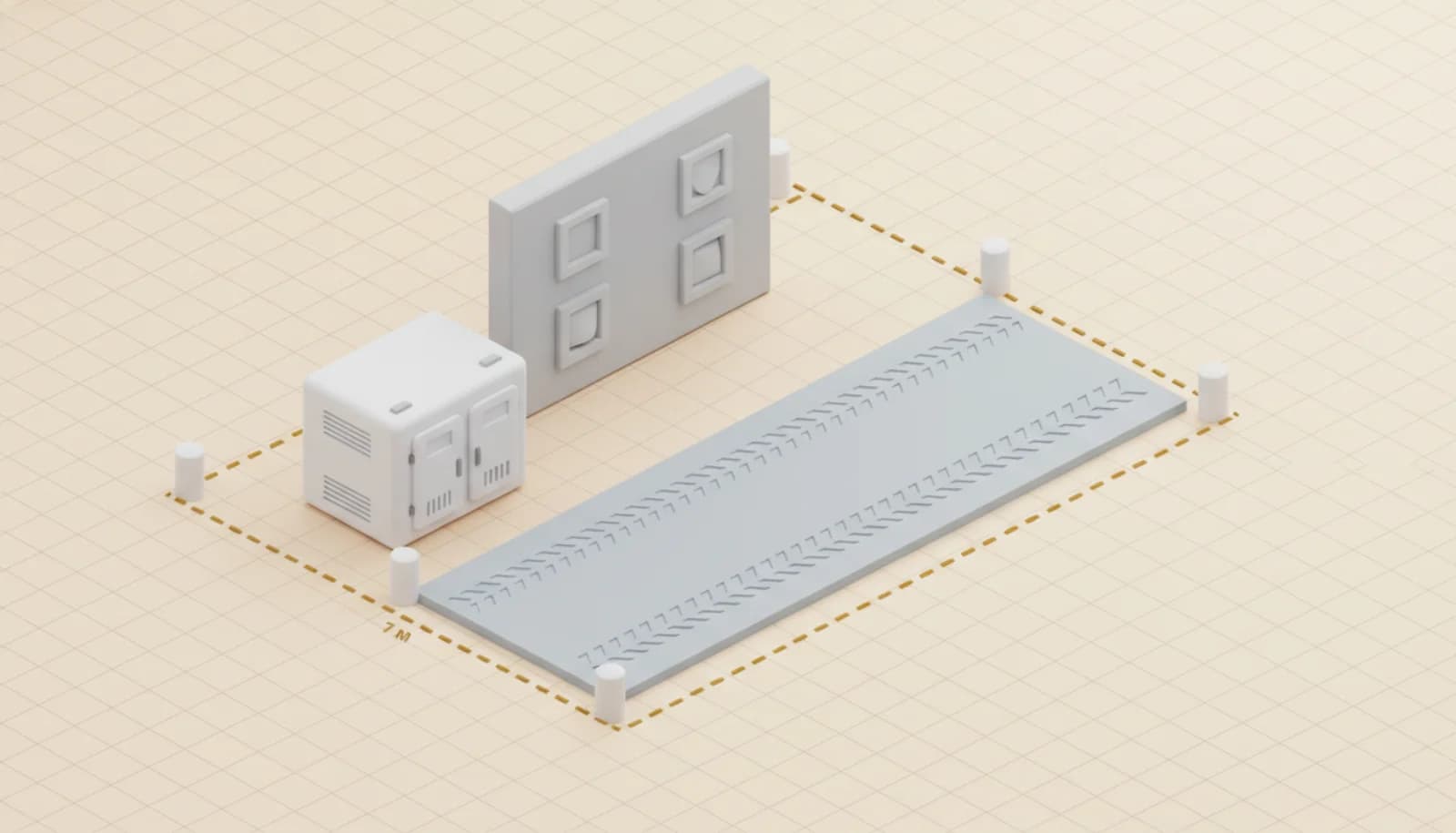
The safety requirements set by the order of 3 August 2018 (updated 2024) are precise. A minimum 7-metre distance separates the control room from the charging area, extendable to 12 metres depending on configuration. An alternative is to place an EI 60 fire wall (REI 60 if load-bearing) between them. If a neighbouring building sits less than 5 metres away and rises above 7 metres, an REI 120 horizontal canopy must shield the battery enclosure (DREAL Corse, 2024).
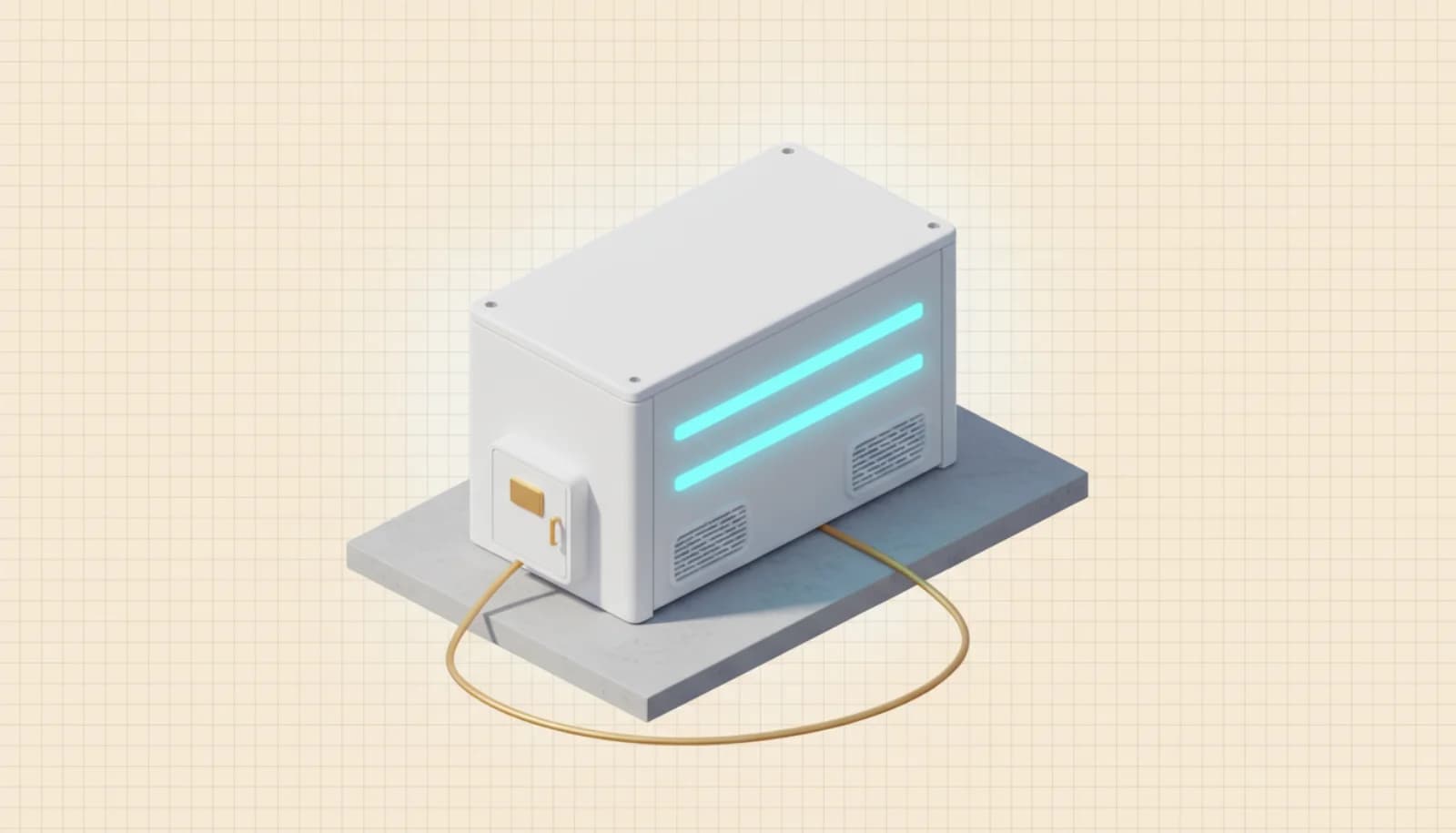
For a supermarket, these constraints naturally point to outdoor placement on a parking lot corner or at the end of a loading dock, inside a 2925-2 certified container. Indoor integration in a technical room remains possible but multiplies costs (compartmentation, smoke evacuation, early detection).
How to Install, Step by Step
A typical deployment on an existing store takes 8 to 12 months from signing to commissioning.
Step 1: Site audit. The aggregator or third-party investor runs a technical visit to qualify the location (parking, technical room, existing connection), available flexible load, and hourly consumption profile. Plan 2 to 4 weeks.
Step 2: Pre-sizing and feasibility study. From the consumption curve (10-minute granularity ideally), the operator sizes the battery (250 kWh / 500 kWh / 1 MWh) and estimates 10-year stacked revenues. Deliverable: a term sheet with revenue split and operating commitment.
Step 3: Enedis grid connection request. For a battery >36 kVA, a PTF (Technical and Financial Proposal) is filed, followed by a CRAE (Connection Agreement). Enedis lead time: 4 to 8 months in LV, 5 to 10 months in HTA.
Step 4: ICPE filing. Submit the 2925-2 declaration dossier at the prefecture with the fire safety report. Receipt within 2-4 weeks for a complete filing.
Step 5: Civil works. Concrete pad, fencing, fire access, electrical groundwork. 4 to 8 weeks.
Step 6: Delivery and commissioning. Install the battery container, HTA/LV connection, compliance verification testing, RTE qualification for aFRR/mFRR (30 to 60 days).
Step 7: Market activation. Register on ancillary services, declare to the capacity mechanism if relevant, set spot arbitrage parameters. First revenues land within 30 days.
Step 8: Continuous operation. 24/7 supervision by the aggregator, cycle monitoring, seasonal strategy adjustment. The battery typically runs 1-2 cycles per day across use cases.
To align this installation with an optimised power supply contract, our bloc + spot procurement guide explains how spot share and physical flexibility reinforce each other.
Frequently Asked Questions
Do I need solar PV to make a battery profitable?
No. A standalone stationary battery monetises market revenues (aFRR, capacity, arbitrage) on its own. Adding PV layers in a self-consumption use case but is not a prerequisite. On new or refurbished sites, the modified S21 order from March 2025 sets the surplus tariff at EUR 0.0473/kWh for the 9-100 kWc segment (Légifrance, 2025), which makes self-consumption more attractive than feed-in.
How much ground area does it need?
For 500 kWh, plan 15-25 m² for the container itself, plus the 7-metre safety perimeter and a fire access lane. Total footprint: 80-120 m², or 5 to 8 parking spaces.
What is the risk to store operations during an aFRR event?
None. The battery injects or absorbs through its own connection, separate from the store's consumption. Refrigeration temperatures, registers and lighting run normally. The battery is operationally transparent to the store.
Can a battery serve as backup during a power outage?
Yes. A backup mode is generally embedded for 1-4 hours of autonomy depending on sizing. Casino La Ricamarie uses it as emergency backup for the store (GreenYellow, 2022). Beyond 4 hours, a diesel genset is more cost-effective.
Which players in France structure these projects?
GreenYellow (Casino group), Tikehau Energy Transition, Mirova, Engie B2B, TotalEnergies, plus battery specialists like Stem, Fluence, Saft, Forsee Power. For second-life, Renault Mobilize Energy and Stellantis. The market consolidated in 2024-2025 and contractual maturity is now comparable to solar PPA.
Your Parking Lots Are Energy Assets. Activate Them
Battery prices fell 45% in one year. France's installed fleet is closing on 1.5 GW and projects 6 GW by 2030 according to industry forecasts. aFRR revenues now reach EUR 50,000-150,000/MW/year on markets opened since 2023. Third-party ownership neutralises the capex barrier. Grocery retail has the locations (parking, technical rooms), the flexible loads (refrigeration, HVAC), and the HTA connections already sized.
The gap between retailers who deploy in 2026 and those who wait until 2028 will be measured in millions of euros per chain. Not in brand image. In recurring cash flow.